Backrooms and liminal space: rooms between uses后室与阈限空间:功能之间的房间
Internet horrorArchitectureVisual culture视觉文化
A liminal space is built for passing through: a corridor, lobby, parking garage, airport gate, hotel stairwell, school after hours. When it is empty or used at the wrong time, its ordinary function drops away. The room remains, but the reason for being there does not. That gap can feel lonely, comic, peaceful, or deeply unsettling.
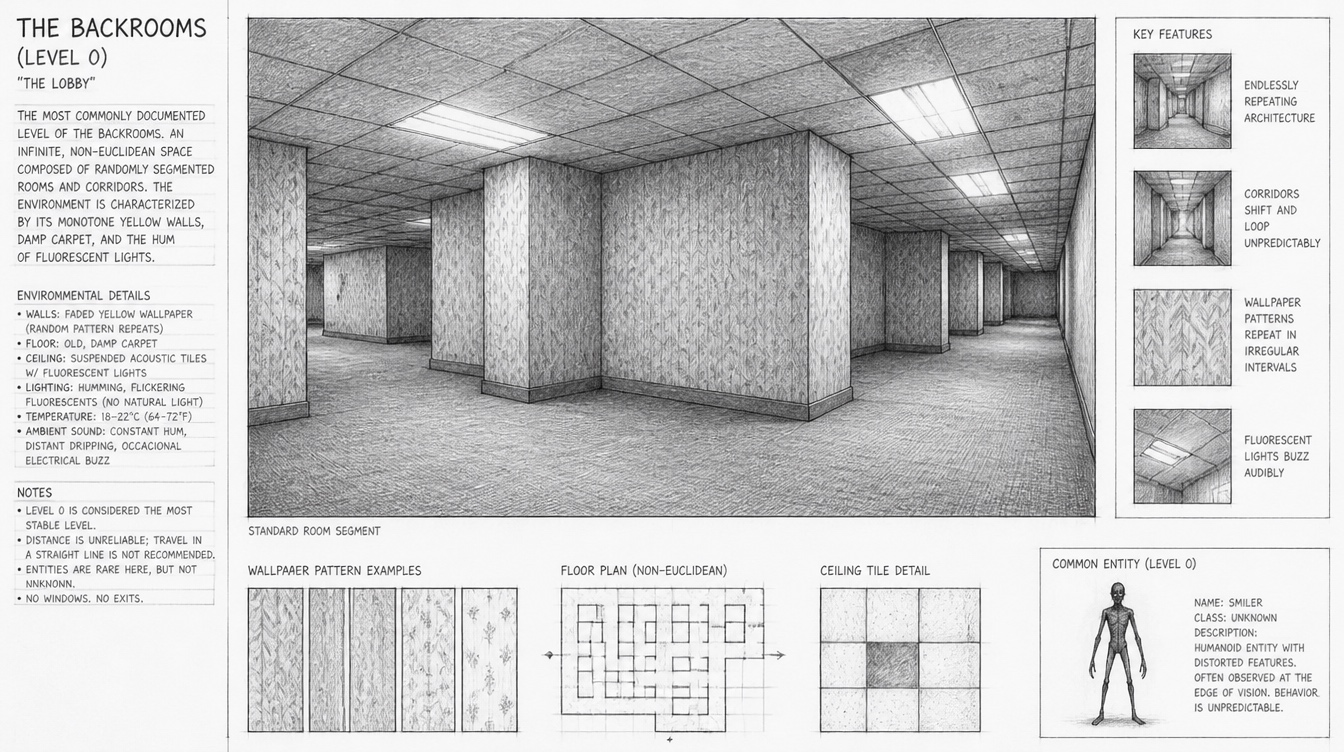
The feeling depends on recognition. Beige carpet, fluorescent hum, patterned wallpaper, and a vending machine with no customers are fragments of everyday infrastructure, stripped of the people who normally explain them.
The Backrooms began with a 2019 anonymous image-board post: a photograph of yellow rooms, paired with a short fictional prompt about "no-clipping" out of reality. Online communities expanded it into levels, entities, survival rules, databases, videos, and games. There is no single official canon. The simplest version often remains the most effective.
Ceilings are too low, halls too long, or furniture feels selected for people who have already left.
Stains, buzzing lights, damp carpet, and outdated finishes suggest a place continuing after its caretakers disappeared.
Doors, corners, and signs imply navigation while withholding a destination.
The room resembles a childhood school, office, mall, or hotel without matching a remembered location.
For film, try Skinamarink for domestic darkness, Pulse for lonely networked spaces, and The Shining for a hotel that swallows orientation. For games, Control makes bureaucratic rooms surreal, The Stanley Parable turns office corridors into a joke about choice, and NaissanceE offers a punishing architectural drift.
Kane Pixels' Backrooms videos use found footage and industrial archaeology. The setting carries the pressure; it needs no catalog of monsters.
It is tempting to give every empty room a lore explanation. Sometimes that helps. Often it makes the image smaller. Let a photo retain its unanswered details: a door with no label, a pool lit at midnight, a classroom with the projector still on. Liminal art works when it leaves enough room for the viewer's own memory to enter.
阈限空间是为“经过”而设计的地方:走廊、大堂、停车场、登机口、酒店楼梯间、放学后的学校。当它空下来,或在不合时宜的时间被使用,原本的功能会突然脱落。房间还在,人却不知道为什么要待在那里。那段空白可以孤独、滑稽、安静,也可以令人不安。
这种感觉依赖于辨认。米色地毯、荧光灯的嗡鸣、花纹壁纸和没有顾客的自动售货机,都是日常基础设施的碎片,只是解释它们的人消失了。
后室始于 2019 年匿名图片板上的一则帖子:一张黄房间照片,加上一段关于从现实中“卡出边界”的简短设定。网络社区后来把它扩写成关卡、实体、生存规则、资料库、视频和游戏。它没有唯一的官方正史,最简单的版本往往也最有效。
天花板过低,走廊过长,家具像是给早已离开的人挑选的。
污渍、嗡响的灯、潮湿地毯和过时装修,让空间像在照料者消失后仍继续运转。
门、转角和标识都暗示可以导航,却拒绝提供目的地。
房间像童年学校、办公室、商场或酒店,却对不上任何一处具体记忆。
电影可以看《Skinamarink》的家庭黑暗、《回路》的网络孤独,以及《闪灵》中吞没方向感的酒店。游戏可以选《控制》的官僚空间超现实感、《史丹利的寓言》对办公走廊和选择的玩笑,以及《NaissanceE》的残酷建筑漫游。
Kane Pixels 的后室视频把这个设定处理成拾得录像和工业考古。空间本身已经足够形成压力,不需要怪物目录。
人很容易想给每个空房间补一段设定。有时这当然有效,但更多时候会让图像变小。可以让照片保留没被回答的细节:没有标签的门、午夜亮着的泳池、投影仪还开着的教室。阈限艺术真正有效,是因为它给观者自己的记忆留出了进入的空间。
“Liminal” originally refers to a threshold, and the online image culture around it gathered places designed for passage rather than staying: empty school corridors, airport gates after closing, hotel atria, office parks at night, pool changing rooms, and suburban playgrounds after rain. The feeling is not tied to decay alone. A spotless room can feel just as wrong when its timetable, audience, or purpose has vanished.
The Backrooms gave this loose visual language a simple narrative engine. A person slips out of ordinary reality and lands somewhere that resembles infrastructure without offering its services. The image arrived before any official worldbuilding, which is why photographs, sound, scale, and pacing remain more important than a definitive map.
Collaborative databases added levels, entities, supplies, and survival rules. This makes an open setting easy to share, though it can turn a strange room into an inventory problem.
Found footage and institutional records use damaged video, training films, and field reports. Kane Pixels' series is a prominent example: the architecture stays central even when the plot grows more elaborate.
Interactive versions let players test the basic fear directly: walking toward a door that promises progress. The best ones use navigation, sound, and restraint rather than constant pursuit.
Liminal images work through partial evidence. A stack of chairs says that a meeting ended. A wet floor sign says somebody expected visitors. A child-sized door in an office corridor suggests that two incompatible uses have been pressed together. Each clue proposes a human routine and then withholds the people who would make it legible.
Sound supplies the missing body. Fluorescent hum, ventilation, distant public-address announcements, water behind a wall, and carpeted footsteps turn a still image into a location that seems to notice the viewer. This is why low fidelity is often helpful: compression noise and weak light leave room for the imagination to finish the room.
For architecture that rearranges authority, try Control. For empty domestic unease, Skinamarink is an austere companion. The Shining makes a hotel into a maze of repetition; Pulse finds isolation inside networks and apartments; The Stanley Parable turns office navigation into an argument with narration. These works do not need to share a canon to share a pressure.
“阈限”原本指门槛或过渡状态。围绕它形成的网络图像文化,收集的正是为经过而不是为停留设计的地点:空学校走廊、打烊后的登机口、酒店中庭、深夜办公园区、更衣室、雨后的郊区游乐场。不安并不只来自破败。一间一尘不染的房间,只要它的时间表、使用者或用途突然消失,也会变得不对劲。
后室为这套松散的视觉语言加上了一个简单的叙事发动机:人从普通现实里滑出去,落进一个像基础设施却不再提供服务的地方。图像出现得早于任何官方设定,所以照片、声音、比例与节奏始终比一张权威地图更重要。
协作资料库补出了关卡、实体、物资与生存规则,方便大家共同接续,也容易把奇怪的房间变成一张需要管理的物品清单。
拾得录像与机构档案借助损坏的视频、培训片和现场记录来叙事。Kane Pixels 的系列是重要例子,剧情越复杂,建筑本身仍然没有退到背景里。
互动作品让人亲自测试那种基本恐惧:朝一扇看似通向进展的门走去。做得好的游戏依靠导航、声音和克制,而不是不停地追逐。
阈限图像依靠残缺的证据。一摞椅子说明会议刚结束,湿地板标识说明有人预计会有访客,办公走廊里的一扇儿童尺寸小门则暗示两种不相容的用途被硬塞在一起。每个线索都提出一套人的日常,同时又把让它成立的人撤走。
声音替补了缺席的身体。荧光灯嗡鸣、通风声、遥远的广播、墙后流水、踩在地毯上的脚步,会让静态图像变成一个仿佛正在察觉观者的位置。低清晰度往往反而有用,压缩噪点和微弱光线把补完房间的工作留给想象。
想看建筑如何重新安排权力,可以试试《控制》;《Skinamarink》以极度克制的方式处理空荡的家庭空间;《闪灵》把酒店变成反复折回的迷宫;《回路》从网络和公寓里找孤立感;《史丹利的寓言》则把办公室导航变成与旁白的争执。这些作品不必共享一套正史,也能共享同一种压力。