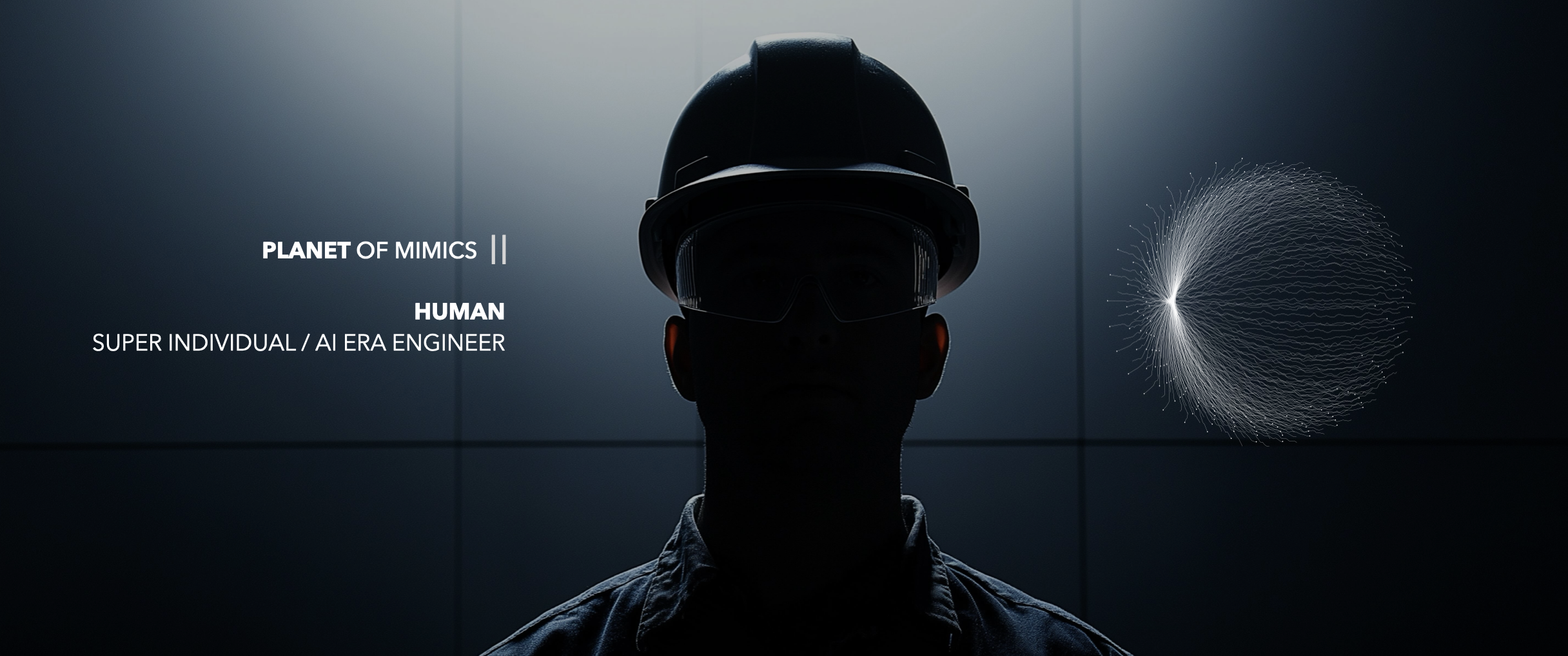
SI
PERSONAL OPERATING SYSTEMSuper Individual
One person.
Many working systems.
A Super Individual combines domain judgment with models, agents, code, and field feedback. The goal is not to appear busy at machine speed. It is to turn one person's intent into work that can be inspected, tested, and reused.
08AI capability families
31projects mapped
01accountable operator
01 / 08
Reasoning
Turn an ambiguous goal into a bounded plan with assumptions, checks, and stop conditions.
Drag to orbit · scroll to zoom · hover a bright node
01
CAPABILITY MAP
The leverage stack
The stack behind individual leverage
No single model creates leverage on its own. The useful unit is a loop: frame the problem, retrieve context, make or run something, measure the result, then retain what survived review.
02
OPEN TOOL RADAR
Tools by job
Choose tools by job, not by hype
This is a working shortlist, not a leaderboard. License badges cover the linked repository only. Model weights, datasets, plugins, enterprise directories, and hosted services may use different terms.
03
OPERATING LOOP
Question to evidence
A repeatable path from question to field evidence
The person keeps authority at the points where context is missing, cost is irreversible, or a decision changes the physical process.
04
Open full screenConsole
PERSONAL AI WORKBENCH
PoM Super Individual Console
Connect enterprise AI services, inspect GitHub Copilot Business usage, pin working models, and operate the bilingual AI Console through chat or slash commands.
Super Individual
Super Individual is a profile extension page for describing a personal operating model: long-term curiosity, self-directed learning, cross-domain execution, and the ability to connect research, product, engineering, and storytelling.
- Research: turn vague industrial problems into structured model concepts.
- Engineering: convert concepts into architectures, runtimes, tools, and reusable workflows.
- Communication: explain complex systems through diagrams, narratives, and product language.
Models and Tools Empower the Super Individual

The technologies on this site divide the work into inspectable parts. DBM/CREEM holds semantic and executable contracts. Workflow Canvas connects authoring to runtime behavior. Mioverse adds spatial and simulation views. SiteScope MultiModal links assets, tags, documents, events, and operational knowledge.
Individual capacity grows when tested work survives the project that produced it. Models preserve reasoning, connectors preserve integration knowledge, workflows preserve decisions, and manuals preserve explanations. AI can then work against explicit structures instead of trying to infer everything from loose prose.
| Site capability | How it empowers an individual |
|---|---|
| DBM / CREEM | Turns behavior, metadata, UI information, data payloads, and resources into one runtime-readable contract. |
| Behavior Tree | Makes sequencing, fallback, retry, halt, OK/FAIL state, and execution visibility explicit. |
| Ontology | Provides semantic anchors for cross-domain vocabulary, asset hierarchy, and reasoning. |
| Workflow Canvas | Transforms IT/OT integration work into visual authoring, reusable workflows, and deployable runtime artifacts. |
| SiteScope MultiModal | Connects documents, historian signals, events, asset structures, and maintenance knowledge into an operational graph. |
| Mioverse | Supports spatial understanding, 3D context, simulation, and digital-twin communication. |
In this operating loop, the person defines intent, constraints, safety boundaries, and domain meaning. Models preserve structure, tools execute and visualize, and AI helps with generation and analysis. Each output still needs evidence appropriate to its cost and risk.
Capability Pattern
| Dimension | Interpretation |
|---|---|
| Depth | Architecture, modeling, runtime, and industrial domain knowledge. |
| Width | AI, IT, OT, visualization, digital twin, and product strategy. |
| Persistence | Long-cycle exploration under uncertainty. |
| Output | Models, prototypes, pages, diagrams, manuals, and reusable concepts. |
Speed with an AI tool is a small part of this role. A Forward-Deployed Engineer (FDE) works close to users, studies operational constraints, turns them into software and data models, and tests the result before every requirement is neat. The Super Individual adds a personal knowledge system so those lessons can be reused.
The required knowledge system is therefore multi-layered: industrial process knowledge, OT safety and reliability principles, IT/cloud architecture, data engineering, semantic modeling, AI agent design, product thinking, and communication. A Super Individual must understand how a PLC signal, a historian tag, an MES order, a 3D digital twin object, an ontology node, and an AI-generated workflow can refer to the same operational reality through different technical surfaces.
- AI literacy: prompt engineering, retrieval-augmented generation, model evaluation, tool calling, agent memory, guardrails, and failure-mode analysis.
- Industrial literacy: control loops, safety interlocks, device capabilities, alarms, historian data, production orders, maintenance workflows, and commissioning constraints.
- Architecture literacy: event-driven systems, API contracts, semantic namespaces, schema governance, container runtime, edge/cloud deployment, and observability.
- Modeling literacy: DBM/CREEM-style behavior contracts, behavior trees, finite-state machines, global data tables, ontology mapping, and digital-twin synchronization.
- Delivery literacy: rapid prototyping, user interviewing, field validation, demo storytelling, technical writing, and iterative productization.
Can AI Fully Replace People in OT?
AI can help with documentation lookup, tag matching, control-code explanation, alarm analysis, simulation, workflow generation, and operator guidance. It cannot hold a permit, inspect a damaged enclosure, hear an abnormal bearing, or accept risk for an asset. Those limits matter more than a model's fluency.
Both IT and OT changes can cause irreversible harm. OT also exposes people, equipment, and process material to direct physical hazards under hard timing constraints. A valve command, robot motion, interlock bypass, or incorrect process parameter can damage equipment or stop a line before a remote service can respond.
- Assigned accountability: the asset owner, employer, engineering authority, approvers, and operators carry duties defined by law, contract, standards, and site procedures. An AI system cannot assume those duties.
- Context incompleteness: OT data is often partial, noisy, delayed, or semantically inconsistent; decisions need field context beyond the available dataset.
- Brownfield reality: factories contain legacy controllers, vendor-specific protocols, undocumented scripts, manual bypasses, and site-specific operational habits.
- Real-time constraints: many OT actions must respect deterministic timing, fail-safe behavior, interlocks, and degraded-mode operation.
- Cross-stakeholder negotiation: production, maintenance, quality, EHS, IT security, vendors, and management often optimize for different constraints.
AI should remain advisory and read-only by default. It must not bypass a basic process control system, safety instrumented system, or robot safety controller. Hard real-time and safety functions stay in validated deterministic controllers. Standards such as IEC 61511, ISA/IEC 62443, and ISA-18.2 provide part of the review context, but the applicable rules depend on the site and jurisdiction.