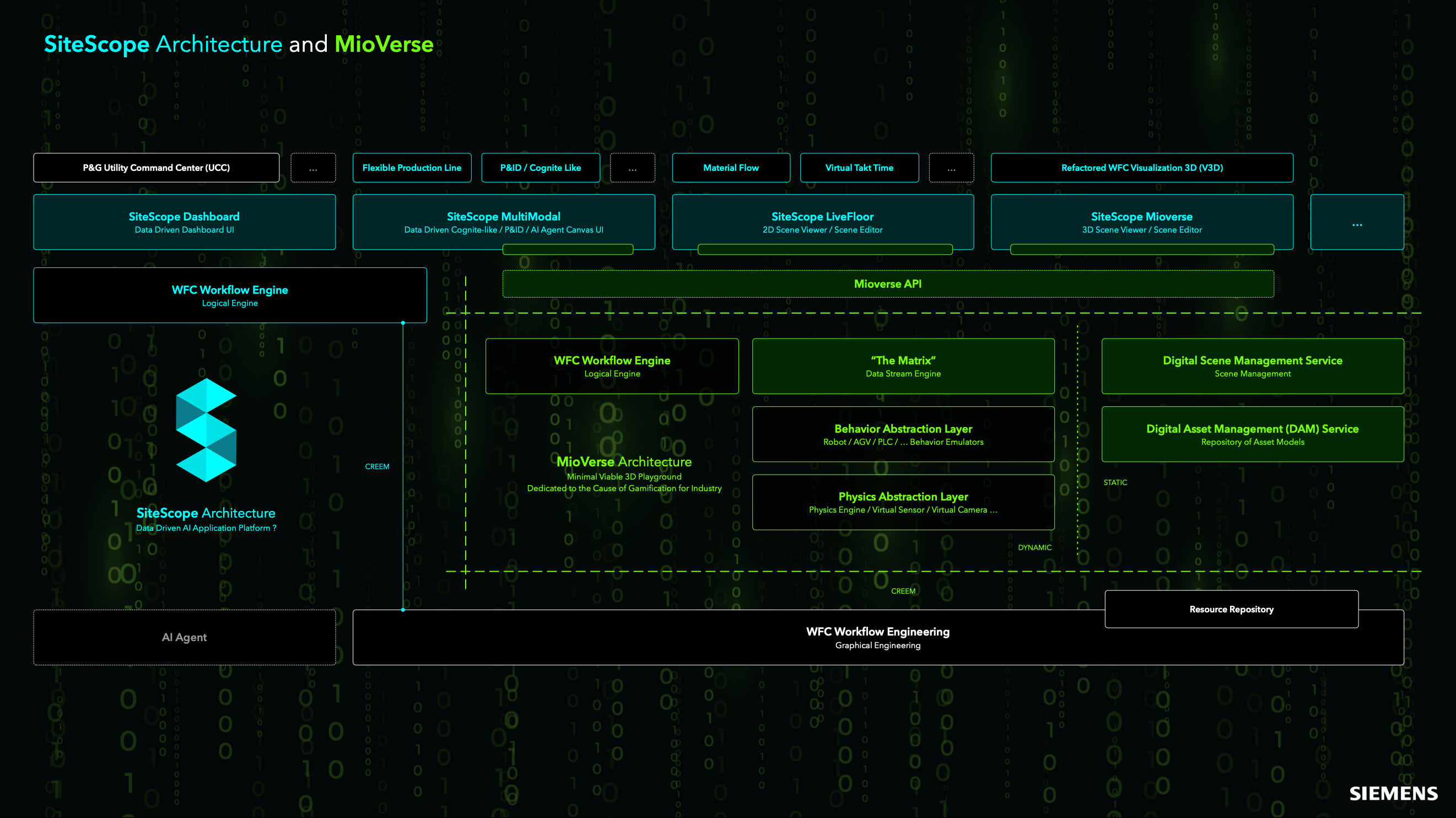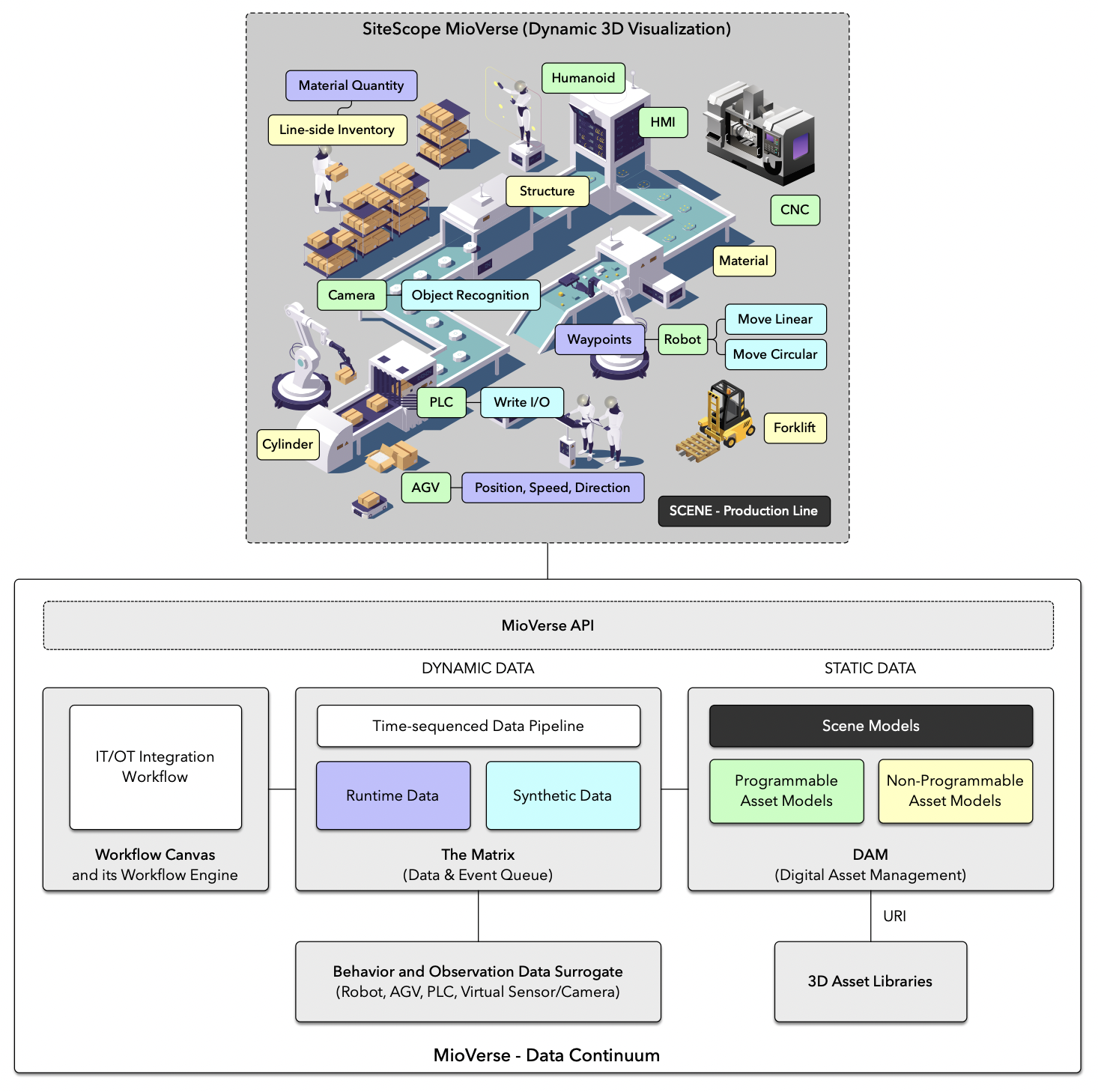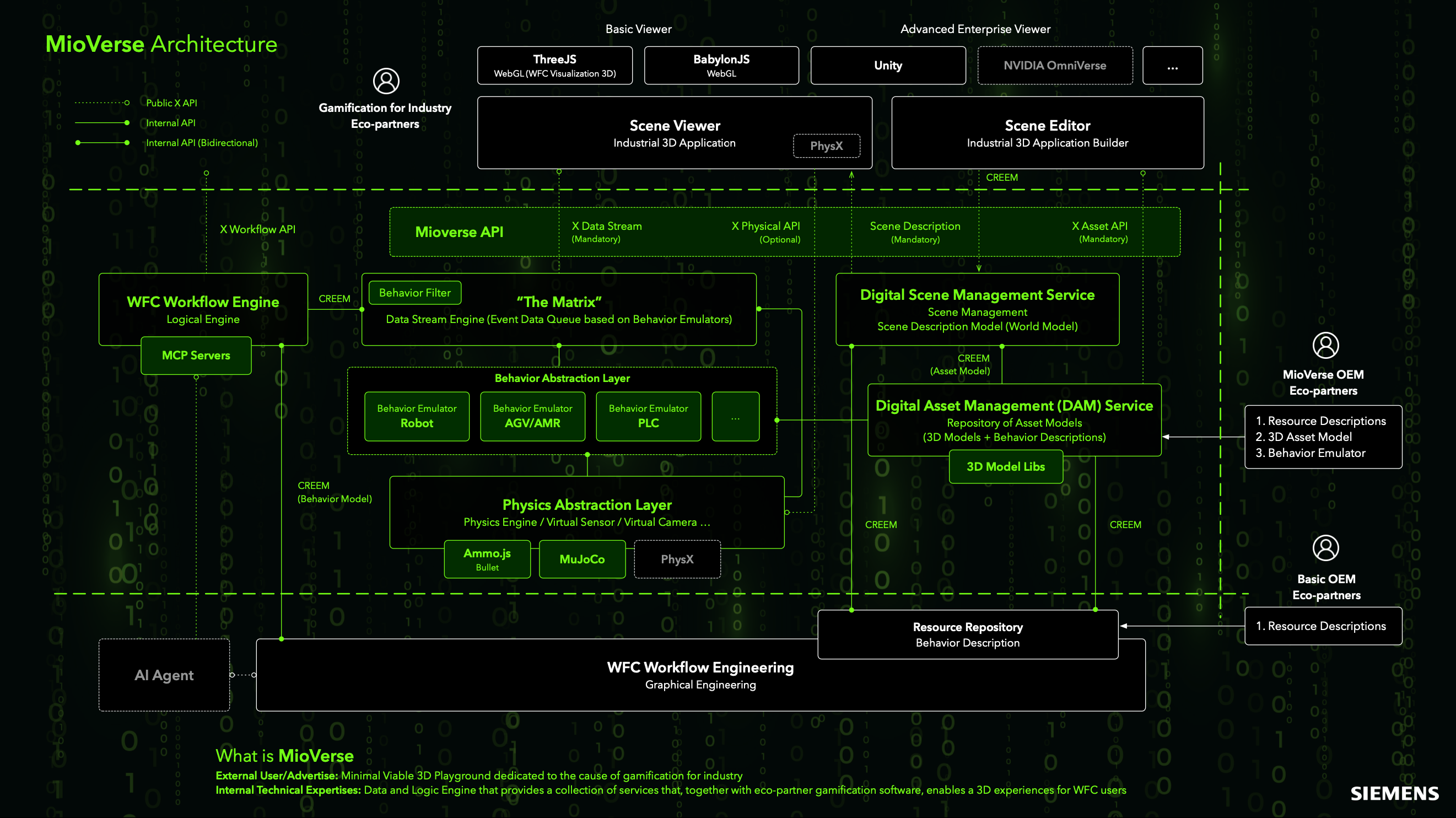
The MioVerse Architecture separates industrial 3D visualization, simulation, data streaming, asset management, and IT/OT workflow orchestration into service layers.
At the top layer, MioVerse supports scene viewers and scene editors. Web clients can use Three.js or BabylonJS; other clients can use Unity or NVIDIA Omniverse. These viewers consume standardized scene descriptions, asset definitions, and data streams to render and interact with industrial 3D applications.
The core integration layer is exposed through the MioVerse API, which provides mandatory interfaces for data streaming, scene description, and asset management, as well as optional physical APIs. This API layer separates visualization clients from execution, data, and simulation services. A client can change without requiring the underlying services to use the same rendering stack.
Dynamic behavior and event data are managed by "The Matrix", a centralized data stream engine that functions as an event-driven queue based on behavior emulators. It aggregates runtime signals produced by robots, AGVs/AMRs, PLCs, and other industrial entities through a dedicated behavior abstraction layer. The layer keeps events in sequence and maps them to a consistent semantic model.
Beneath this layer, the physics abstraction layer integrates multiple physics engines and virtual sensing technologies, such as Ammo.js, MuJoCo, and PhysX, to model motion, collision, and perception. This allows physical behaviors and virtual sensors or cameras to be treated as first-class data sources.
Static and semi-static knowledge is governed by the Digital Scene Management Service and the Digital Asset Management (DAM) Service. These services maintain world models, scene descriptions, asset models, and associated 3D model libraries, linking structural definitions with reusable behavior descriptions via standardized resource identifiers.
On the orchestration side, the WFC Workflow Engine provides a logical execution environment for IT/OT integration workflows, while WFC Workflow Engineering enables graphical authoring and lifecycle management of behaviors and control logic. AI agents can query this layer for scene context and submit actions through governed workflow interfaces.
MioVerse connects visualization and physics simulation to runtime data and workflow logic. Internal teams and partners can use the same interfaces to build digital-twin applications or game-like industrial training scenes.