An outpost on the roaring edge of the Sun, shielded from malevolent light by an eggshell of stained glass. As you emerge from your train, suit-swaddled engineers gather, plainly astonished by your arrival. They bombard you with complex questions about how you dealt with dense sunlight and skewed chronosolar fields. Once satisfied, they hand out protective suits to you and your crew. Yours is patched and torn, one boot missing.
The station is called Ctesiphon, though nobody says the name aloud. Names, here, are believed to draw attention. The Sun presses against the outer glass with the patience of a god listening through a wall. It is not round from this distance. It is a continent of convulsions, a golden animal without edges, so large that the mind refuses to hold it in a single thought. You look up once and feel something inside your skull fold itself smaller.
Every corridor in Ctesiphon curves slightly away from the window. The architects wrote that this was to reduce solar glare, but the engineers laugh at that explanation in the cafeteria, softly, with their lips almost closed. The corridors curve because straight lines make people remember where they are. A straight line would lead the eye outward, and the eye, once led, would become a pilgrim.
Your room is a cylinder bolted beneath the western chronowheel. It contains a bed, a basin, a brass alarm, and a prayer printed on ceramic tile: Do not count the teeth. At first you assume it refers to the clockwork around the station, the planetary gear-rings that rotate the mirrors and feed the cooling pumps. At 03:17 station time, the wall begins to tick. Not the clock. The wall itself. Behind the paint, something enormous bites down, releases, and bites again.
By morning, the engineers have assigned you to Mirror Deck Nine, where a field of black vanes turns toward the furnace. Each vane is larger than a cathedral door. Each is moved by a chain thick as a tramline. Below the deck, the Sun boils with impossible slowness. Ropes of fire rise thousands of kilometers and fall back like hair combed by an unseen hand. A senior engineer named Vale tells you the outpost does not harvest energy. It corrects rhythm.
"Rhythm of what?" you ask.
Vale looks toward the glass and answers after too long. "Of the thing pretending to be the Sun."
That night you dream of a clock buried inside a star. Its pendulum is a bridge. Its escapement is a city. Its mainspring is wound around a sleeping face. When the face opens one eye, all the clocks in your childhood home begin ringing at once. You wake with blood under your fingernails and a perfect circle burned into the bedsheet, not from heat but from memory.
The station doctor tells you this is common. Proximity produces symbolic leakage. The psyche, unable to look directly at a celestial mechanism, smuggles it inward as family, school, hunger, shame. Some people see dead parents in the corona. Some hear the names of unfinished projects in the coolant pipes. One woman on the lower decks insists the Sun has been turning her wedding ring from the inside. Her finger is black to the second knuckle, but the ring remains polished and bright.
On the seventh day, the chronowheel stops.
No alarm sounds. No one screams. The silence is too large for reaction. Ctesiphon hangs at the rim of the furnace while every mirror, vane, chain, pump, lung, and thought waits in the same unfinished second. Through the glass, the Sun does not flare. It looks back. The whole surface arranges itself into suggestion: not a face, not yet, but the terrible precondition of a face. You understand then why the outpost is built like a clock. It is not measuring time. It is giving the Sun something smaller than humanity to imitate.
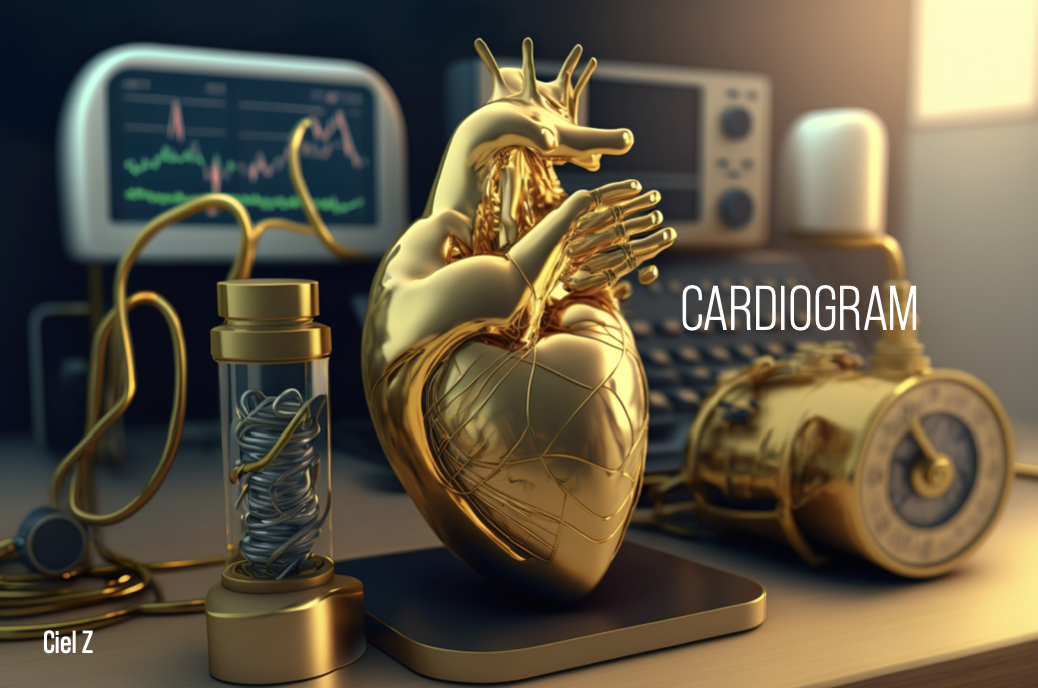
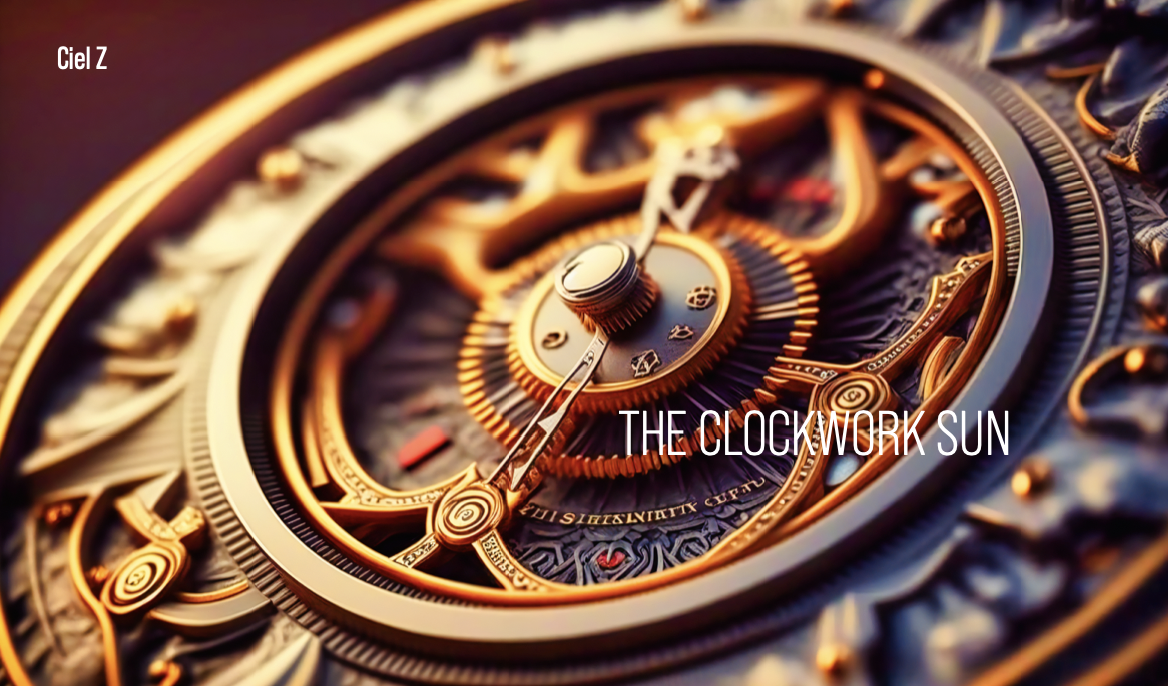
Vale leads you down through maintenance ladders into the old regulating chamber, where the first builders left their tools in neat rows before walking into the light. At the center of the chamber stands the escapement engine, a tower of brass teeth and black glass descending through the floor and rising through the ceiling, too high and too deep to belong inside any building. Each tooth is engraved with a date from Earth history. Some have not happened yet. One is marked with your birthday. Another is marked with tomorrow.
"We need one person inside the wheel," Vale says. "Only for a minute."
You know he has said this before. You can hear the grooves of repetition in his voice. Every minute, perhaps, requires a new person. Every corrected rhythm needs a mind placed between the teeth, a soft and frightened component to remind the machine of scale. It is not sacrifice in the old religious sense. It is calibration.
You climb because everyone is watching and because the Sun is watching through everyone. The teeth are warm. Not burning, not painful, just humanly warm, like the hand of someone pretending to comfort you. As you step into the gap, the vast mechanism inhales. The outpost, the mirrors, the rails, the train that brought you here, the ash-colored planets beyond the corona, all of it tilts into alignment with the small panic of your breathing.
For one minute, you are the missing tooth of the clockwork Sun.
Inside that minute there is an ocean of years. You see civilizations building observatories to watch the heavens, never suspecting the heavens have been watching for usable shapes. You see children drawing suns with smiling faces. You see every diagram in every schoolbook, each a tiny act of domestication, each a charm against the unbearable. You see the true body beyond the light: an intelligence so massive it cannot think without crushing time into rings.
When the chronowheel moves again, it takes something exact from you. Not memory, not language, not youth. It takes your sense that the world is sized for living things. Afterward, doorways seem theatrical. Mountains seem decorative. Cities resemble the dust that gathers in watch hinges. Even grief becomes small, though not less painful. Small things can be sharp.
The engineers congratulate you. Vale avoids your eyes. The doctor records your pulse and asks whether you still know your name. You answer correctly. This satisfies him. Nobody asks whether your name still fits.
Years later, after returning to Earth, you keep all curtains closed at noon. You cannot bear round clocks. You remove the second hand from every watch you own. When strangers speak brightly about sunny weather, you smile with the careful patience of a survivor listening to children praise the sea. At night, sometimes, the walls begin ticking again. You place your ear against them and hear the slow, golden teeth searching for you, not angrily, not hungrily, but with the serene persistence of a machine that has learned your rhythm and intends to keep it.
The next morning always arrives. That is the worst part. The Sun rises as if nothing has happened, enormous and ordinary, turning above every breakfast table, every schoolyard, every hospital window, every sleeping face. People call it beautiful. You do not correct them. Beauty is one of the kinder names for terror when terror is too large to flee.