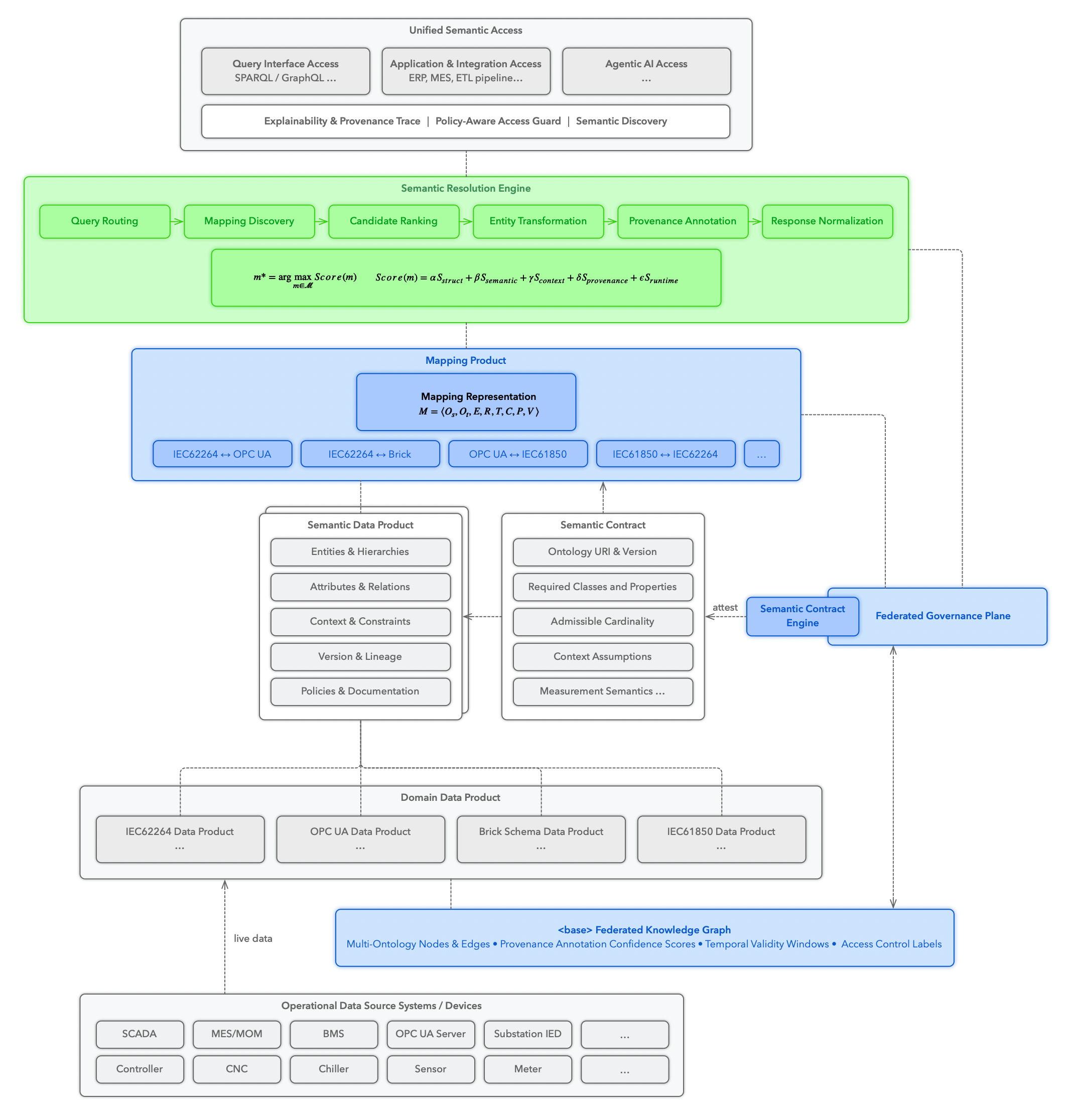
The architecture combines domain ownership from Data Mesh with the shared semantics, governance, and resolution services of Data Fabric. Each industrial domain keeps its data products and ontology vocabulary. Shared services handle cross-domain queries, mapping, lineage, and access for AI tools.
There is no single central ontology. Each domain publishes a governed Domain Data Product and a Semantic Data Product. Versioned Mapping Products define the links between ontologies. Software can discover, query, and compose these mappings at runtime, so they do not become hidden spreadsheet crosswalks.
| Layer |
Technical role |
| Domain Data Product |
Publishes source-domain data with ownership, quality boundaries, and ontology-aligned metadata. |
| Semantic Data Product |
Exposes ontology terms, entity graphs, contextual semantics, constraints, and lifecycle metadata. |
| Mapping Product |
Publishes ontology mappings as versioned products with confidence, provenance, and transformation rules. |
| Federated Governance Plane |
Registers schemas, semantic contracts, trust rules, lineage, quality policies, and deprecation rules. |
| Semantic Resolution Engine |
Discovers mappings, ranks candidates, composes transformations, normalizes units, and annotates provenance. |
| Unified Semantic Access |
Provides SPARQL/GraphQL/API/tool endpoints for applications, ETL pipelines, dashboards, and agentic AI tools. |
For process plants, DEXPI can anchor P&ID semantics. The ingestion pipeline converts Proteus XML into an entity graph, resolves RDL class references, normalizes attributes, and binds each element to a CREEM Resource Description. It also maps valves, pumps, instruments, and other active elements to Function Blocks. The fabric can then compare both structure and operating behavior.
- Reusable mapping products replace hand-maintained pairwise integrations.
- Industrial agents query asset, behavior, document, and event knowledge through one semantic access layer.
- Query results can include the mapping version, confidence, source lineage, and semantic-contract constraints.
- Mappings are resolved on demand, which makes ontology version changes visible to downstream applications.