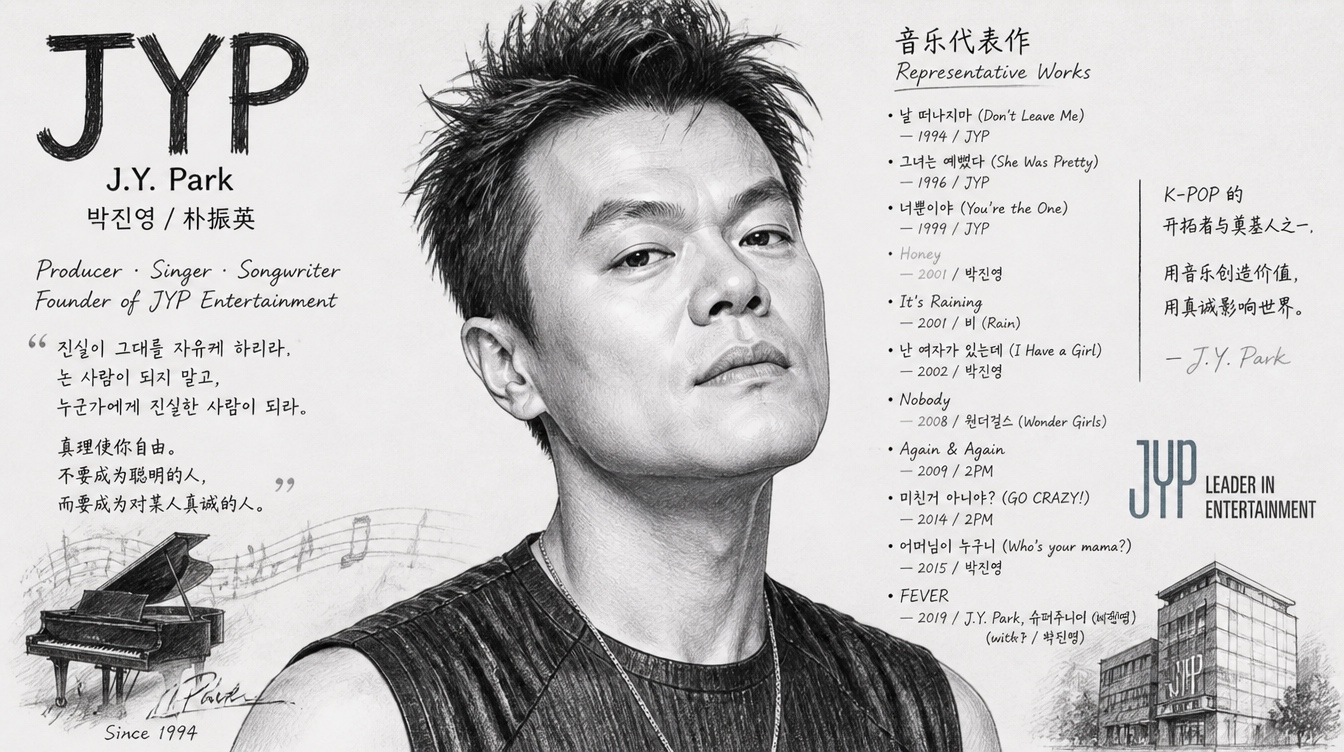
JYP, the Craft of K-pop, and the Producer-PerformerK-pop的制作之道,与身兼制作人和表演者的朴振英
Park Jin-young / J.Y. ParkSinger-songwriter创作歌手JYP Entertainment founderJYP 娱乐创办者Producer / mentor / performer制作人 / 导师 / 表演者
Park Jin-young, widely known as J.Y. Park or JYP, is one of the key producer-performers in Korean popular music. He began as a singer and dancer in the 1990s, built a public image around groove, body control, and direct pop performance, then became even more influential as a songwriter, producer, executive, and founder of JYP Entertainment.
His career follows two lines of K-pop history. On stage, he works with retro R&B, funk gestures, dance-pop hooks, falsetto theatricality, and a willingness to look uncool if the performance remains memorable. Behind the stage, he built systems for auditions, training, vocal habits, choreography, brand management, and the company pipeline used by groups such as Wonder Girls, 2PM, miss A, GOT7, TWICE, Stray Kids, ITZY, and NMIXX.
What makes JYP especially interesting is that he is legible both as an individual taste-maker and as an institution-builder. Many pop figures leave behind a repertoire; JYP leaves behind a production grammar. His fingerprints can appear in vocal phrasing, hook structure, performance discipline, and even in the way idols are coached to balance accessibility, repetition, confidence, and televised personality.
That is why he matters beyond fandom. To read JYP closely is to read one version of how K-pop industrialized charisma: how style became training, how training became brand consistency, and how brand consistency became a globally exportable entertainment system.
Listen for an older pop grammar: stage charisma, R&B phrasing, funk basslines, dance breaks, and songs that often treat embarrassment as part of performance.
He belongs to a generation in which live persona mattered as much as audio polish. His presence is often slightly theatrical, rhythm-first, and knowingly excessive, which is precisely why it remains memorable.
His production identity is clearest in hooks that sound simple but are built for repetition, live stage readability, and easy memory after one chorus.
Underneath that accessibility is craft discipline: arrangement economy, phrasing built for choreography, and melodic design that allows songs to survive television stages, fan chants, and short-form repetition.
The label's best-known groups make his influence visible at scale: clean performance discipline, bright choruses, personality-forward idols, and polished variety presence.
At company scale, “JYP” becomes less a single sonic signature than a management aesthetic: disciplined trainees, clear group identity, emotionally readable performance, and a form of pop that travels well across domestic and international audiences.
This table separates direct JYP songwriting/production involvement from broader JYP Entertainment system support. The album links open Apple Music store pages and the covers are loaded from Apple Music artwork URLs.
| Group / Artist | Album | Representative Song | JYP Relation | Cover | Store |
|---|---|---|---|---|---|
| Wonder Girls | Nobody (The Remix Edition) | "Nobody" | Direct producer-songwriter era; one of JYP's clearest global crossover attempts. |  | Apple Music |
| 2PM | Hands Up | "Hands Up" | Company flagship boy-group era; performance masculinity, dance hooks, and variety presence. |  | Apple Music |
| miss A | A Class | "Bad Girl Good Girl" | JYP-produced debut framework: minimal hook, stage clarity, and immediate brand identity. |  | Apple Music |
| GOT7 | Just Right - EP | "Just Right" | Company-era idol optimism; JYP as label architect more than sole sonic author. |  | Apple Music |
| TWICE | Feel Special | "Feel Special" | JYP-written emotional thesis for the group: vulnerability turned into bright reassurance. |  | Apple Music |
| Stray Kids | GO LIVE | "God's Menu" | Later JYP system with strong in-house group authorship; the company supports a self-producing identity. |  | Apple Music |
| ITZY | IT'z Different - Single | "DALLA DALLA" | Company brand renewal: teen confidence, sharp choreography, and self-definition messaging. |  | Apple Music |
| NMIXX | AD MARE - EP | "O.O" | Fourth-generation experiment under the JYP pipeline: mix-pop structure and high-difficulty performance. |  | Apple Music |
JYP establishes himself as a solo singer-dancer, building the physical performance vocabulary that later becomes part of his training philosophy. This period matters because his later executive identity never fully abandons the performer’s eye: body rhythm, stage readability, and affective immediacy remain central.
JYP Entertainment grows from founder-led production into a training company, connecting songwriting, choreography, casting, and television visibility. What develops here is both a business and an idol-making workflow in which musical authorship, performance discipline, and media image are designed together.
The company enters a hit-making phase: retro hooks, performance variety, and clean concept packaging define its second-generation idol profile. This is also the period when JYP's public identity as producer, selector, and architect of mainstream taste becomes difficult to separate from the company itself.
TWICE turns bright repetition, personality balance, and emotional accessibility into a global JYP signature, while JYP continues writing key material. The group demonstrates how the company learned to engineer intimacy at scale: catchy enough for mass replay, but emotionally legible enough to feel personal.
Stray Kids, ITZY, and NMIXX show different extensions of the company: self-production, confidence branding, and experimental performance architecture. The important shift is that the JYP system becomes more plural, less dependent on one sonic mold, while still preserving high discipline and sharp identity design.
JYP's career shows how K-pop moves between performer and institution. His taste on stage informed a training doctrine; that doctrine shaped group identities and songs for global markets. The response from those markets then influenced what the company expected from its next generation of performers.
He is also useful as a case study in pop modernity. In his career, authorship is never purely individual and never purely corporate; it circulates between body, studio, television, trainee system, fan expectation, and platform visibility. That circulation is one of the reasons K-pop can feel at once intimate and industrial.
Seen historically, JYP stands for a particular answer to a large question: how do you manufacture repeatable pop excellence without entirely losing the sense of personal presence? His career does not solve that tension so much as dramatize it, and that is precisely why it remains analytically rich.
朴振英,常以 J.Y. Park 或 JYP 为名,是韩国流行音乐中非常关键的“制作人型艺人”。他在 1990 年代以歌手、舞者身份出道,舞台形象建立在律动、身体控制和直接的流行表演上;随后他又作为词曲作者、制作人、公司经营者和 JYP 娱乐创办者,获得了更广泛的影响力。
他的职业生涯沿着 K-pop 的两条线展开。舞台上的朴振英使用复古 R&B、放克姿态、舞曲 hook 和假声戏剧感;即使显得不酷,只要表演能让人记住,他也愿意去做。舞台背后,他建立了选秀、训练、发声习惯、编舞与品牌管理体系,并形成支持 Wonder Girls、2PM、miss A、GOT7、TWICE、Stray Kids、ITZY 和 NMIXX 等组合的公司流程。
JYP 特别值得讨论的地方,在于他既可以被看作一个强烈的个人品味制造者,也可以被看作一个把这种品味制度化的人。很多流行人物留下的是作品目录,而朴振英留下的更像是一套生产语法:副歌如何构造、舞台怎样被阅读、声音如何服务表演、偶像怎样被训练成既可复制又要显得独特。
因此,他的重要性不只属于粉丝文化,也属于流行工业史。透过 JYP,可以看到 K-pop 如何把魅力工业化:如何把个人风格转化为训练原则,再把训练原则变成品牌一致性,最终变成一种可以向全球输出的娱乐结构。
可以听他较早一代的流行语法:舞台魅力、R&B 唱法、放克低音线、舞蹈段落,以及把尴尬感也变成表演材料的能力。
他所属的那一代,现场存在感并不亚于录音室精致度。很多表演带着一种略微夸张、节奏优先、甚至有意冒险的身体性,这也正是他为什么至今仍有辨识度。
他的制作人身份常体现在看似简单的副歌里:容易重复、适合舞台、听过一遍后就能留在记忆中。
这种“简单”背后其实有很强的工艺意识:编曲留白、为编舞服务的句法、适合电视传播的段落组织,以及让歌曲在一次副歌之后就建立可回忆性的能力。
JYP 娱乐旗下组合把他的影响放大到工业尺度:清晰的表演纪律、明亮副歌、强调人格感的偶像,以及成熟的综艺呈现。
到了公司层面,“JYP” 已经不只是某种声音,而是一种管理美学:高纪律训练、明确团体人格、情感可读的舞台,以及兼顾韩国本土与国际传播的可理解性。
这张表区分 JYP 本人直接参与词曲/制作的情况,以及更广义的 JYP 娱乐训练体系和公司支持。专辑链接打开 Apple Music 商店页面,封面图来自 Apple Music artwork。
| 组合 / 艺人 | 专辑 | 代表歌曲 | JYP 关系 | 封面 | 商店 |
|---|---|---|---|---|---|
| Wonder Girls | Nobody (The Remix Edition) | 《Nobody》 | JYP 直接制作/词曲参与最典型的全球化尝试之一。 | | Apple Music |
| 2PM | Hands Up | 《Hands Up》 | 公司旗舰男团阶段:表演型男性气质、舞曲 hook 和综艺存在感。 | | Apple Music |
| miss A | A Class | 《Bad Girl Good Girl》 | JYP 参与打造的出道框架:极简 hook、清晰舞台和立刻可辨识的组合身份。 | | Apple Music |
| GOT7 | Just Right - EP | 《Just Right》 | 公司体系下的偶像乐观主义;JYP 更像厂牌建筑师,而非唯一声音作者。 | | Apple Music |
| TWICE | Feel Special | 《Feel Special》 | JYP 为 TWICE 写下的情感命题:把脆弱转化成明亮的互相确认。 | | Apple Music |
| Stray Kids | GO LIVE | 《God's Menu》 | 后期 JYP 体系中的强自制组合:公司支持一种自我生产的偶像身份。 | | Apple Music |
| ITZY | IT'z Different - Single | 《DALLA DALLA》 | 公司品牌更新:少女自信、锐利编舞和自我定义式宣言。 | | Apple Music |
| NMIXX | AD MARE - EP | 《O.O》 | JYP 流水线下的四代实验:mix-pop 结构和高难度表演。 | | Apple Music |
JYP 以独唱歌手和舞者身份确立舞台语言,身体控制和律动后来也成为他训练理念的一部分。这个阶段的重要性在于,他之后的经营者眼光始终没有脱离表演者视角:身体如何说话、节奏如何被看见、舞台如何抓住注意力,始终是核心问题。
JYP 娱乐从创办人主导的制作结构,逐渐发展成连接词曲、编舞、选拔和电视曝光的训练公司。此时成长起来的不只是企业规模,更是一套偶像制造流程:音乐、表演、媒体人格和市场可读性开始被同时设计。
公司进入强 hit 阶段:复古 hook、表演综艺感和清晰概念包装共同定义二代偶像轮廓。也是在这一时期,JYP 作为制作人、选择者和主流口味塑造者的身份,开始与公司品牌本身难以分开。
TWICE 把明亮重复、成员人格平衡和情感亲近性变成全球化 JYP 标识,JYP 也继续参与关键作品写作。这个阶段特别能说明 JYP 如何把“可亲近的流行性”做成规模化输出,而不是只靠单次爆红。
Stray Kids、ITZY 和 NMIXX 展现了公司不同延伸方向:自我制作、自信品牌,以及实验性表演结构。重要的变化在于,JYP 体系开始变得更复数化,不再依赖单一声音模板,但仍保留强训练纪律和鲜明身份设计。
JYP 的职业经历清楚展示了 K-pop 如何在表演者与机构之间运转。他的舞台品味进入训练体系,训练体系再塑造组合身份和面向全球市场的作品;市场反馈又反过来改变公司对下一代艺人的要求。
他同时也是观察流行现代性的绝佳样本。在他的职业生涯里,作者性既不完全属于个人,也不完全属于公司,而是在身体、录音室、电视、训练体系、粉丝期待与平台传播之间不断流动。这种流动,正是 K-pop 为什么能够同时显得亲密又工业化的重要原因之一。
从更大的历史尺度看,朴振英代表的是一种问题意识:如何在大规模训练和商业复制中,仍然保留“舞台上有一个人正在发光”的感觉。他并没有真正消除这种张力,而是把它长期维持在可运转状态中,这也正是他最值得分析的地方。