Cosmic Horror / Cthulhu Mythos宇宙恐怖 / 克苏鲁神话

Lovecraft and the Cthulhu Mythos洛夫克拉夫特与克苏鲁神话

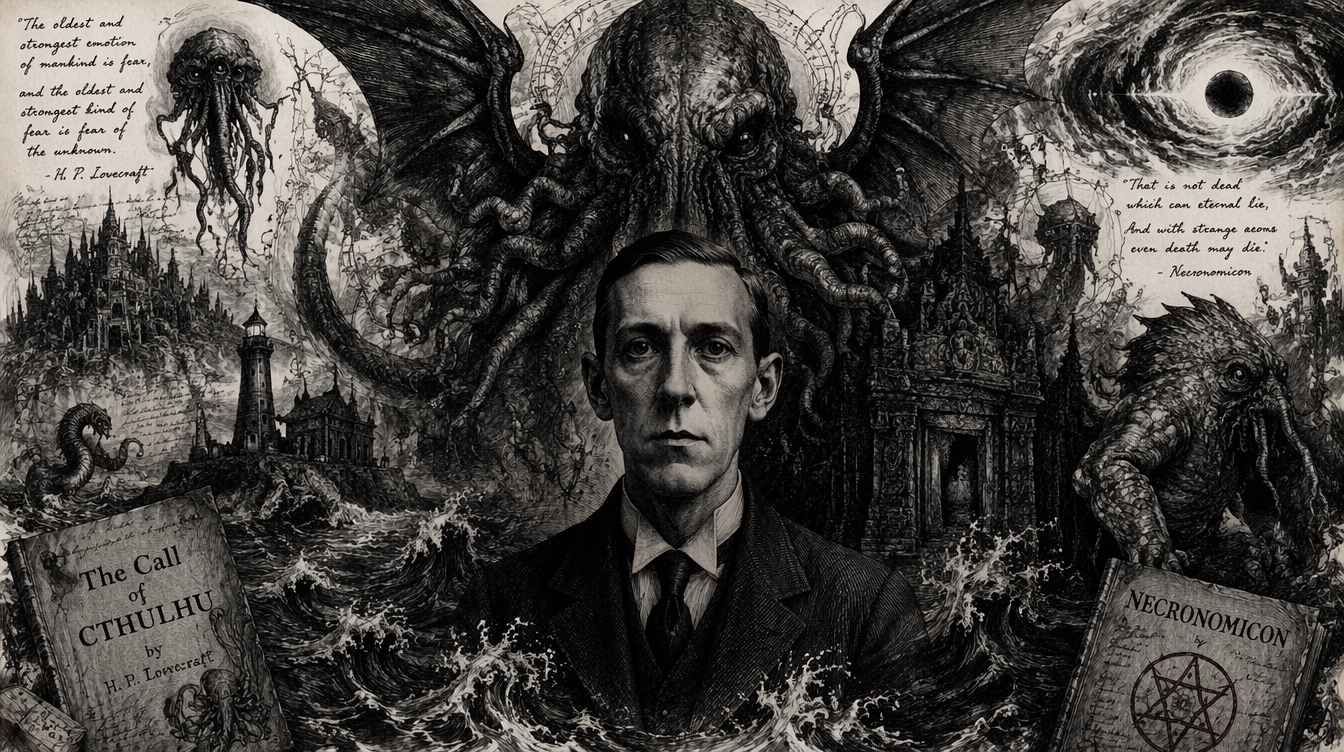
A bilingual shelf for H. P. Lovecraft's life, major stories, the global appeal of cosmic horror, and the beings whose presence makes humanity feel temporary, provincial, and dangerously curious.这一页集中整理 H. P. Lovecraft 的生平、主要作品、宇宙恐怖之所以在全球持续流传的原因,以及那些一旦现身,便会让人类意识到自身短暂、局促且危险地渴望认知真相的存在。

H. P. Lovecraft portrait
H. P. Lovecraft 霍华德·菲利普斯·洛夫克拉夫特
1890-1937 / Providence, Rhode Island1890-1937 / 美国罗德岛州普罗维登斯

Lovecraft lived much of his life in Providence, writing fiction, essays, letters, and amateur journalism while rarely achieving commercial security. His fiction developed a distinctive cosmic horror: human beings are not central to the universe, knowledge is often destructive, and ancient nonhuman forces dwarf ordinary moral categories. His racism and xenophobia are real parts of the historical record and should be read critically; the modern Mythos is also a field where later writers have revised, challenged, and expanded his inheritance.

洛夫克拉夫特一生大部分时间居住在普罗维登斯,持续写作小说、随笔、书信与业余刊物,却始终很少真正获得稳定的商业回报。他所建立的宇宙恐怖传统,最鲜明之处在于彻底动摇“人类居于中心”的想象:知识往往具有破坏性,古老而非人的力量远远超出日常伦理所能衡量的范围。与此同时,他的种族主义与排外倾向也是不可回避的历史事实,必须在阅读中保持批判性视角;而现代克苏鲁神话则早已不只是他的个人遗产,更是后来作者不断修订、挑战与扩展的开放场域。

Why the Mythos Drew Global Attention克苏鲁神话为何持续引发全球关注

Lovecraft's worldview became globally influential because it gives modern anxiety a durable shape. It replaces the familiar ghost or devil with deep time, astronomy, forbidden archives, unstable perception, and the fear that the universe is not hostile so much as indifferent. The Mythos is also modular: later writers, games, comics, films, tabletop RPGs, and internet culture can add entities, cults, ruins, documents, and local histories without needing one official canon.

洛夫克拉夫特式世界观之所以具有全球影响力,在于它为现代人的焦虑提供了一种极其耐久的表达形式。它不再诉诸传统意义上的鬼魂或恶魔,而是以深时、天文学、禁忌文献、感知失稳,以及“宇宙是根本漠视人类”的恐惧,取代旧式恐怖叙事的中心位置,不是仇恨人类。与此同时,克苏鲁神话还具有极强的模块化能力:小说、游戏、漫画、电影、桌面 RPG 与互联网文化都可以不断向其中加入新的实体、邪教、遗迹、档案与地方历史,而无需服从一部唯一的官方正典。

Mythos Hierarchy, Relations, and World Elements神话层级、关系网络与世界观要素
Cthulhu Mythos worldview background
Worldview Background世界观背景

The Cthulhu Mythos operates as a shared pattern of cosmic horror rather than a single strict canon: the universe is ancient, crowded, and indifferent; human civilization is recent; forbidden books, ruined cities, dreams, cults, astronomy, archaeology, and failed science briefly reveal deeper orders of reality. Its drama usually begins when a human witness discovers that monsters, gods, alien species, and prehistoric histories are connected by scale rather than by morality.

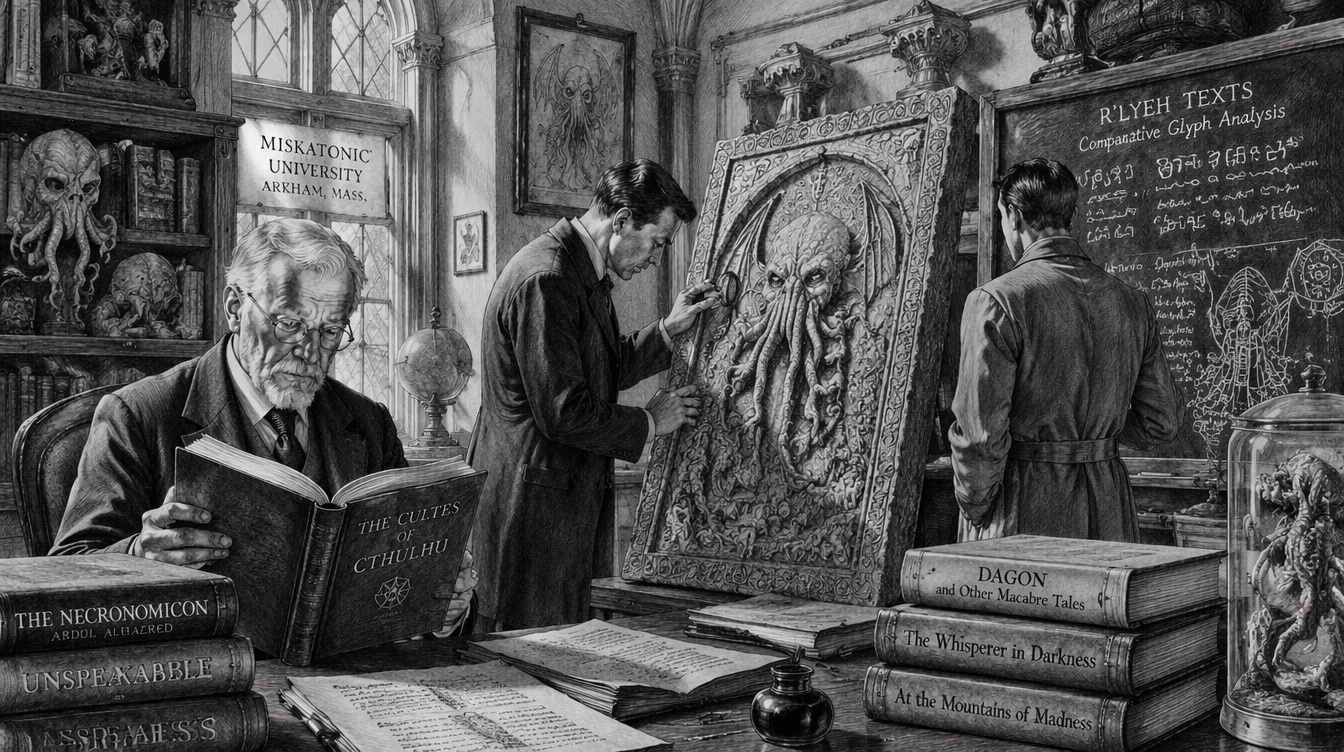
Its world is built from recurring channels of contact. Texts such as the Necronomicon preserve names and rituals; places such as R'lyeh, Innsmouth, Dunwich, and the Antarctic city turn geography into evidence; institutions such as Miskatonic University translate curiosity into danger; dreams and altered perception connect private experience to nonhuman space. The Mythos therefore works less like a kingdom of monsters and more like a hidden ecology of time, matter, worship, ancestry, and forbidden interpretation.

克苏鲁神话没有单一、严格的正典,而是由共享的宇宙恐怖模式连接起来:宇宙古老、拥挤且漠然;人类文明只是晚近现象;禁书、废墟城市、梦境、邪教、天文学、考古学与失败的科学实验,会短暂揭开更深层的现实秩序。它的戏剧性通常始于人类见证者发现:怪物、神祇、异星种族和史前历史之间的关系,不由道德决定,而由尺度决定。

它的世界由一系列反复出现的接触通道构成:《死灵之书》一类文本保存名字与仪式;R'lyeh、印斯茅斯、敦威治、南极古城把地理变成证据;密斯卡托尼克大学让求知转化为危险;梦境与异常感知把私人经验连接到非人空间。因此克苏鲁神话并不像一个“怪物王国”,更像时间、物质、崇拜、血统与禁忌解释共同组成的隐秘生态。

NecronomiconR'lyehMiskatonic UniversityDreamlandsDeep TimeForbidden KnowledgeCults
Azathoth and Outer Gods visual reference
Rank I / Cosmic Principles第一层 / 宇宙原则
Outer Gods 外神
Azathoth / Yog-Sothoth / Nyarlathotep / Shub-Niggurath

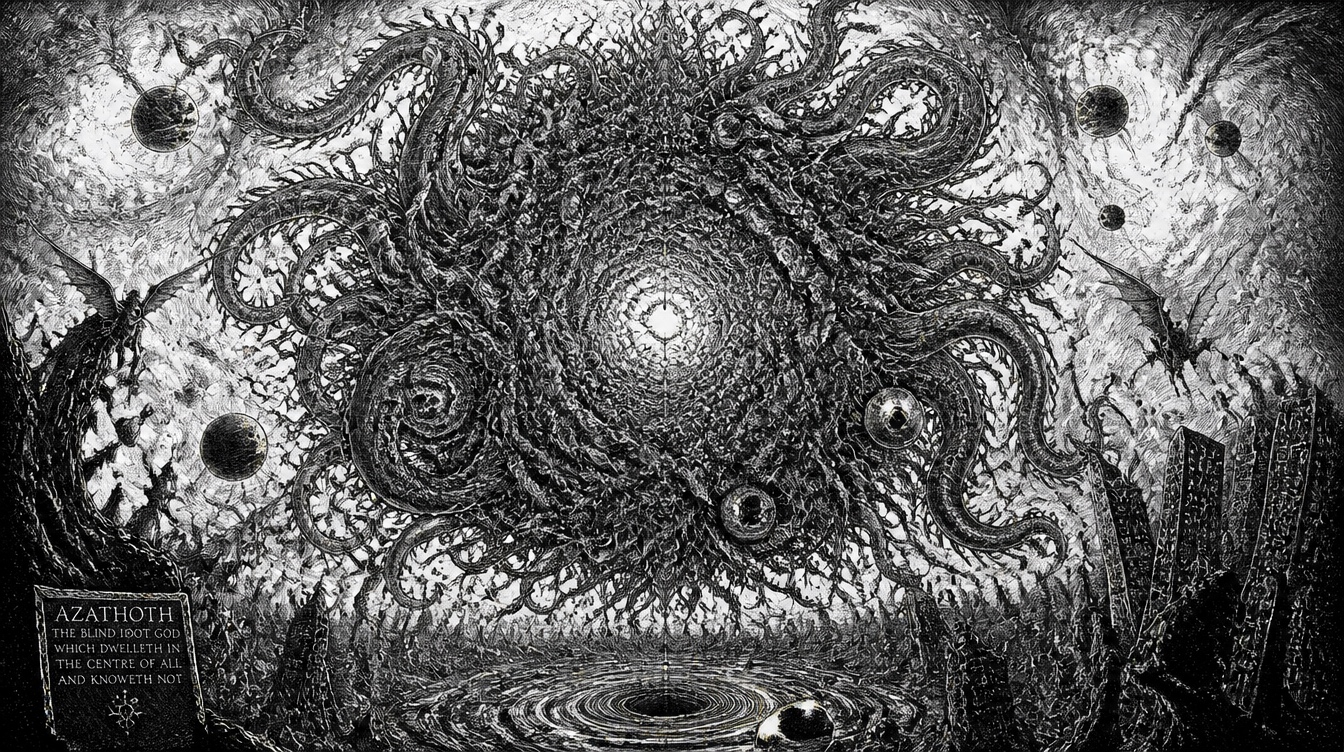
Outer Gods sit at the highest and least human level. They function as cosmic conditions, with none of the political authority implied by rulers: Azathoth suggests blind nuclear chaos at the center of all things; Yog-Sothoth is the gate and the key, linking time, space, and thresholds; Shub-Niggurath turns fertility into an alien, excessive principle; Nyarlathotep translates this remote scale into action.

Their terror comes from abstraction. They do not need motives humans can read. They make the universe feel structurally unsafe, because even reality's basic laws may be expressions of powers that never noticed us.

外神处在最高、也最远离人类的层级。它们不是政治意义上的统治者,而更像宇宙条件:Azathoth 指向万物中心盲目的核混沌;Yog-Sothoth 是门与钥匙,连接时间、空间与门槛;Shub-Niggurath 把繁殖变成异质而过剩的原则;Nyarlathotep 则把这种遥远尺度转译为行动。

它们的恐怖来自抽象性。它们不需要人类能理解的动机。它们让宇宙本身显得结构性不安全,因为现实的基本法则也可能只是某些从未注意到人类的力量的表现。

Nyarlathotep visual reference
Rank I-A / Active Messenger第一层 A / 主动信使
Nyarlathotep 奈亚拉托提普
Outer God / messenger / mask-wearer外神 / 信使 / 千面者

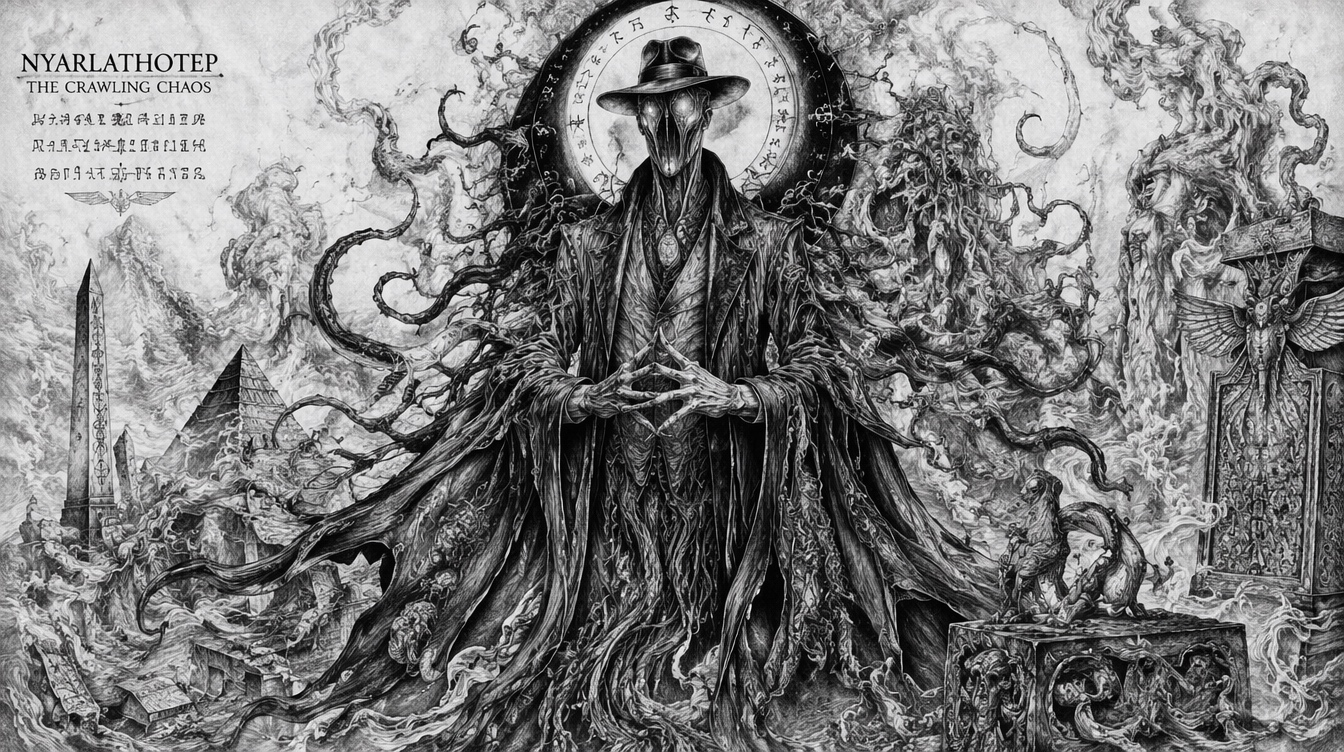
Nyarlathotep is the most socially dangerous of the Outer Gods because he approaches humans directly. Where Azathoth is blind distance and Cthulhu is dreaming pressure, Nyarlathotep speaks, performs, deceives, organizes cults, wears masks, and turns civilization's own media, science, spectacle, and charisma into instruments of cosmic contact.

Nyarlathotep 是外神中最具社会危险性的存在,因为它会直接接近人类。Azathoth 是盲目的遥远,Cthulhu 是梦眠中的压迫,而 Nyarlathotep 会说话、表演、欺骗、组织邪教、佩戴面具,并把文明自身的媒介、科学、奇观和魅力变成宇宙接触的工具。

Hastur and Great Old Ones visual reference
Rank II / Sleeping Powers第二层 / 沉睡力量
Great Old Ones 旧日支配者
Hastur / Tsathoggua / Yig / Ghatanothoa / Dagon and Hydra

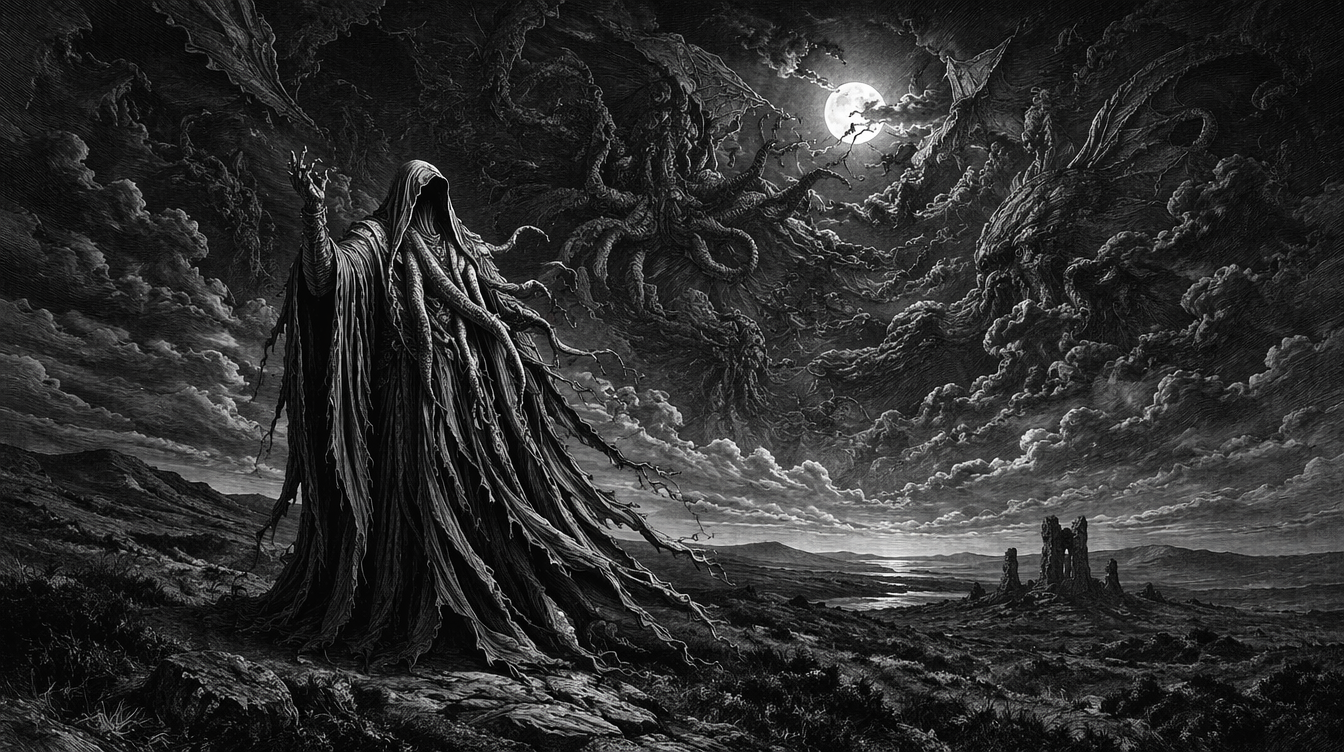
Great Old Ones are immense but more localized than the Outer Gods. Many are buried, sleeping, imprisoned, or tied to a city, planet, sea, star, cult, or bloodline. Hastur works well as this rank's emblem because later Mythos traditions connect him to the King in Yellow, forbidden performance, contagious signs, and the unstable border between literature, ritual, and revelation.

This rank is where cosmic horror becomes almost physical. A Great Old One has geography, worshipers, symbols, sleeping places, and sometimes offspring or servitor races. It may be unreachable for an era, yet its pressure leaks into language, dreams, art, inheritance, weather, and madness.

旧日支配者巨大而可怖,但比外神更局部。许多处于埋藏、沉睡、封印状态,或与城市、星球、海洋、星辰、邪教、血脉绑定。Hastur 很适合作为这一层的代表,因为后来的神话传统把它与黄衣之王、禁忌演出、传染性符号,以及文学、仪式和启示之间不稳定的边界连接起来。

在这一层,宇宙恐怖开始变得近乎实体化。旧日支配者拥有地理位置、崇拜者、符号、沉睡之处,有时还有后裔或仆役种族。它也许在某个时代无法真正抵达,但压力会渗入语言、梦境、艺术、遗传、天气和疯狂。
Cthulhu visual reference
Rank II-A / Dreaming Great Old One第二层 A / 梦眠旧日支配者
Cthulhu 克苏鲁
R'lyeh / oceanic depth / cult transmissionR'lyeh / 深海 / 邪教传播

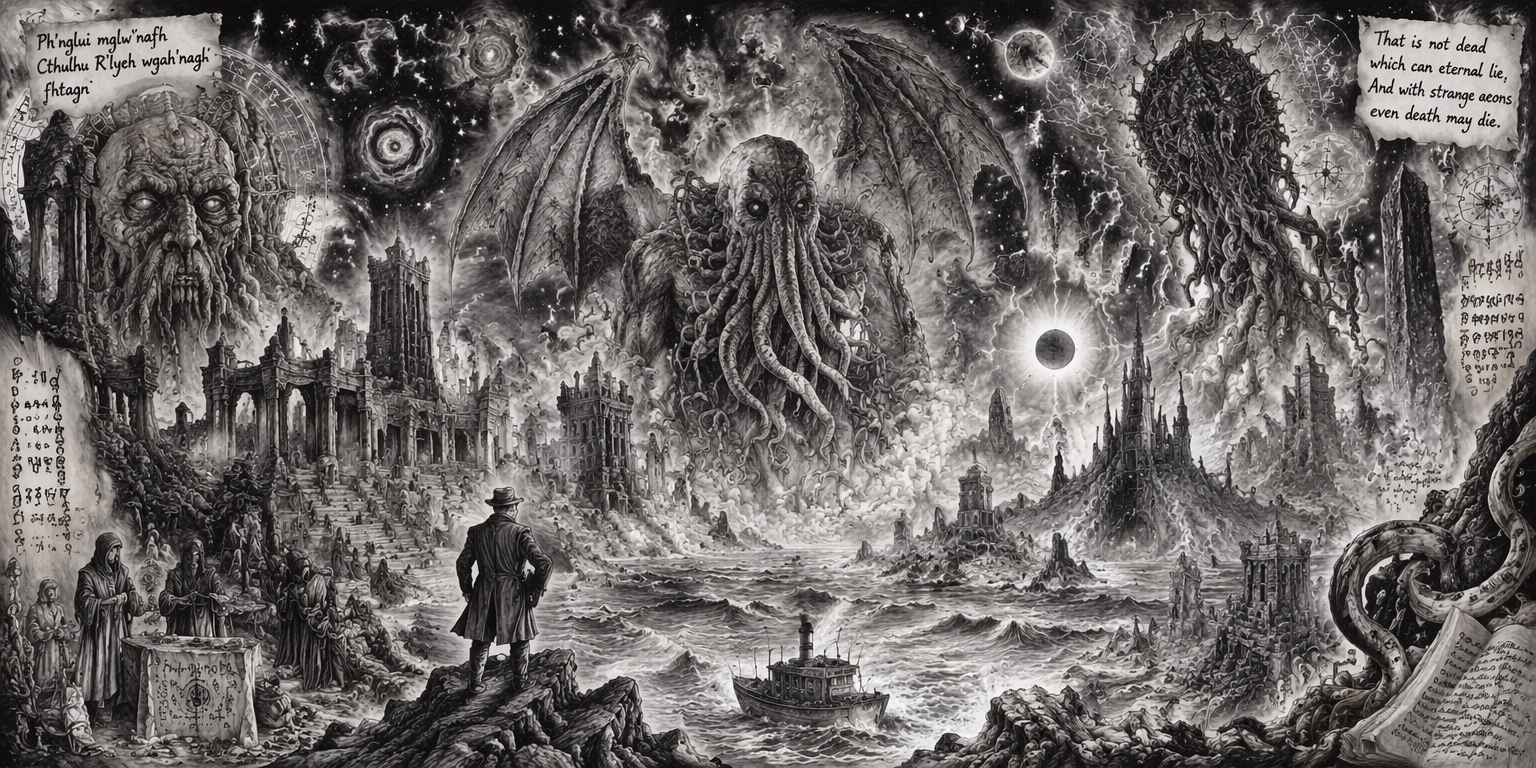
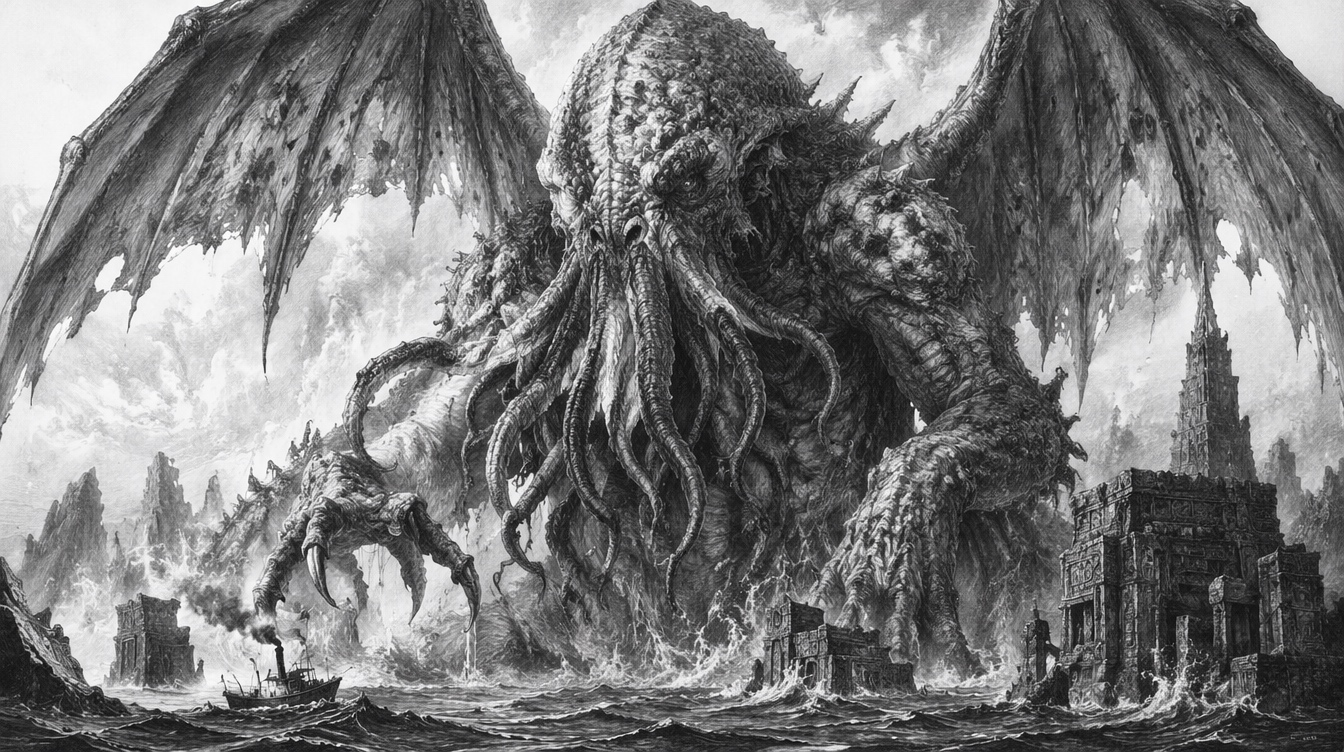
Cthulhu is the most recognizable Great Old One and the Mythos' central icon. He is not simply a monster in the sea: he is a sleeping pressure system linking prehistoric extraterrestrial arrival, the sunken city of R'lyeh, dream contact, sculptural symbols, scattered cults, and the possibility that human history is only a pause in an older occupation.

Cthulhu 是最具辨识度的旧日支配者,也是整个神话体系的核心图像。它不只是海中的怪物,而是一套沉睡中的压力系统:把史前异星降临、沉没之城 R'lyeh、梦境接触、雕像符号、分散邪教,以及“人类历史只是更古老占据中的暂停”这一可能性连接起来。

Border gods and liminal powers visual reference
Rank III / Rival Cosmic Layer第三层 / 对位宇宙层
Elder Gods and Border Figures 古神与边界存在
Nodens / Hypnos / Bast / later Mythos protectors

Lovecraft's own fiction leaves this layer loose, while later Mythos writing sometimes turns Elder Gods into opposing or restraining powers. They are useful as a map label, but less central than the indifferent Outer Gods and sleeping Great Old Ones.

This layer should be read carefully: it is not a clean good-versus-evil pantheon. It is a later interpretive zone for boundaries, seals, dream guardians, partial protections, and ambiguous powers that seem to resist one cosmic force without necessarily caring about humanity.

Lovecraft 原作中这一层相当松散,后来的神话写作有时把古神塑造成制衡或压制旧日力量的存在。它们适合作为阅读地图中的标签,但不如冷漠的外神和沉睡的旧日支配者核心。

这一层需要谨慎理解:它是后续解释中用于容纳边界、封印、梦境守护、局部保护与暧昧力量的区域,并非简单的善恶神系。它们可能抵抗某种宇宙力量,却未必真正关心人类。

Ancient alien races visual reference
Rank IV / Prehuman Civilizations第四层 / 史前文明
Ancient Alien Races 古老异族
Elder Things / Great Race of Yith / Mi-Go / Flying Polyps / Serpent People

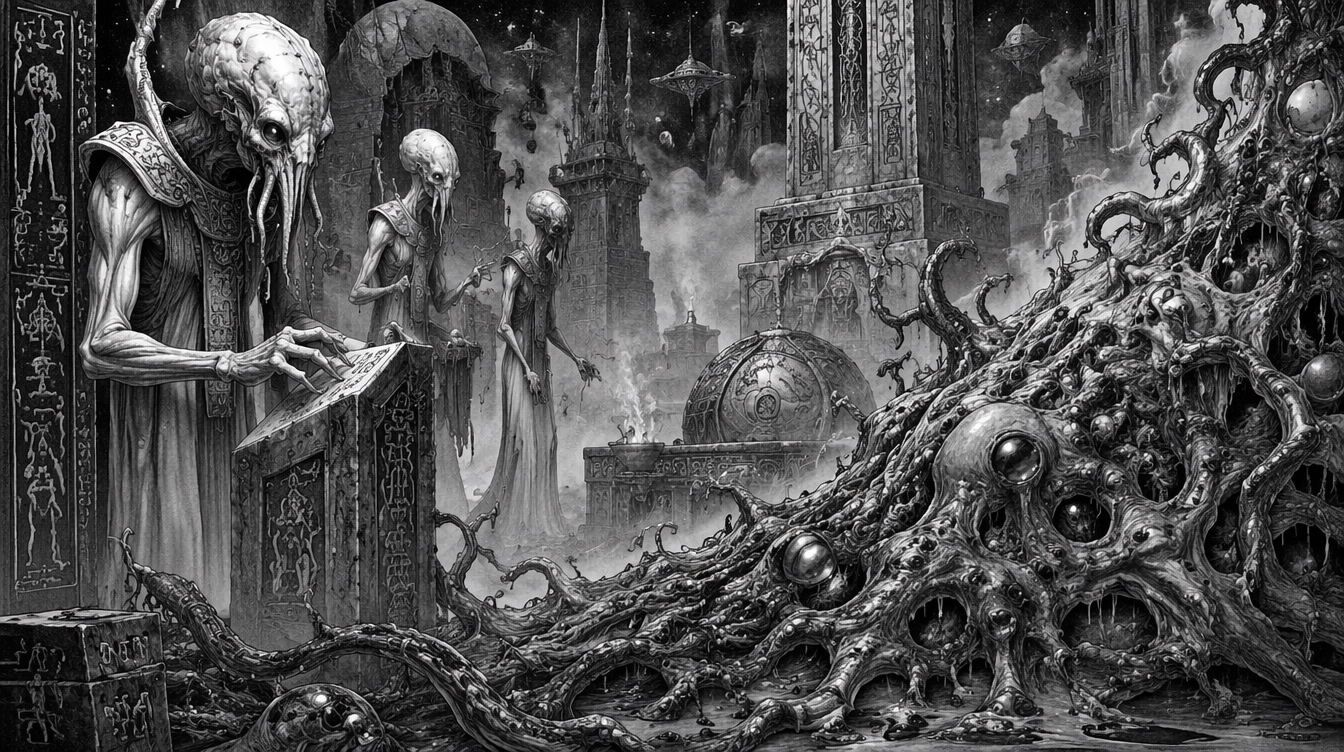
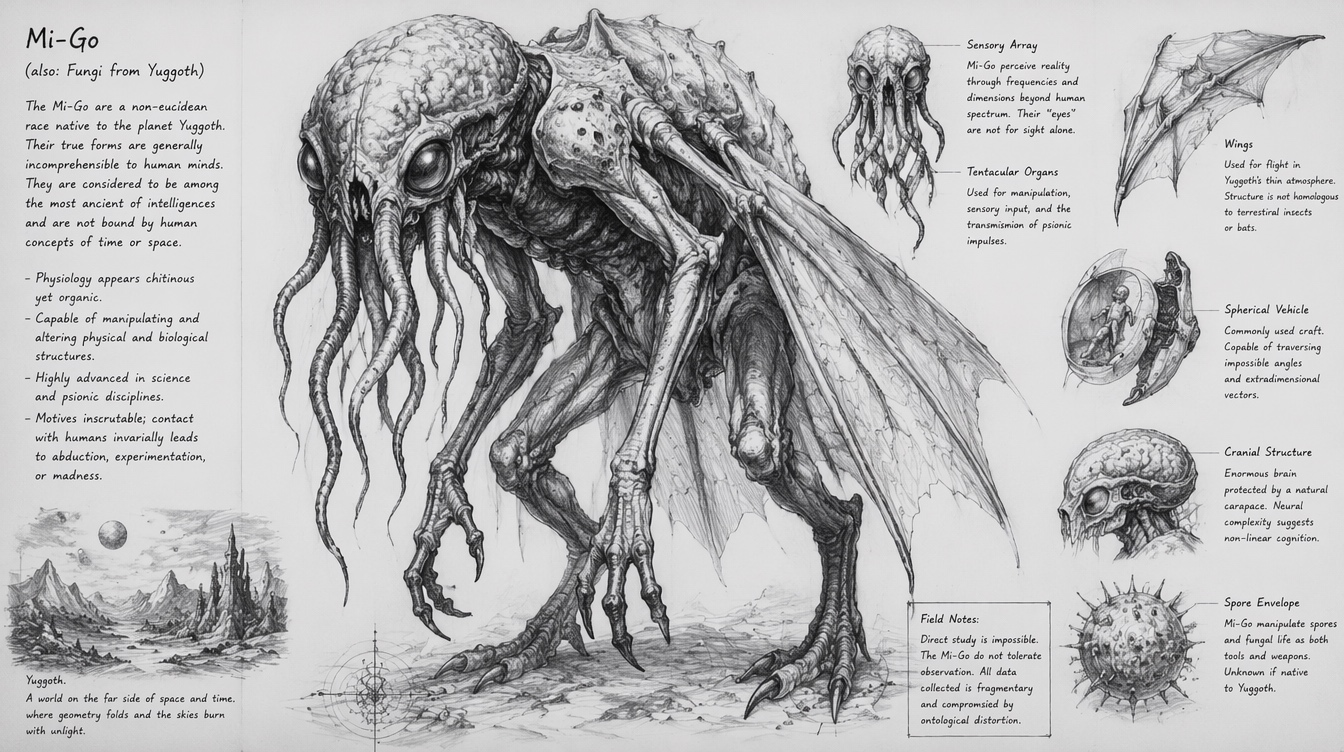
These beings belong to civilizations with science, cities, wars, archives, migration, engineering, and decline. They make Earth feel occupied before humanity: the Elder Things built Antarctic cities, the Yith exchange minds across time, the Mi-Go mine and transport brains, and other races mark older territorial layers.

They also change the genre. The story stops being only supernatural horror and becomes archaeology, xeno-history, and failed anthropology. A haunted ruin also becomes evidence that humanity inherited a planet already written over by other technical cultures.

这些存在是拥有科学、城市、战争、档案、迁徙、工程与衰落史的文明,并非神。它们让地球显得在人类之前早已被占据:古老者建造南极城市,Yith 伟大种族跨时间交换意识,Mi-Go 采矿并运输大脑,其他种族则标记更古老的领地层。

它们也改变了类型感:故事不再只是超自然恐怖,而变成考古学、异星史和失败的人类学。一处遗迹不只是闹鬼,而是证明人类继承的是一颗早已被其他技术文明反复书写过的星球。

Deep Ones, shoggoths, and servitors visual reference
Rank V / Servitors and Hybrid Peoples第五层 / 仆役与混血族群
Servitors, Monsters, and Local Races 仆役、怪物与地方种族
Shoggoths / Deep Ones / Star-spawn of Cthulhu / Byakhee / Night-gaunts / Ghouls

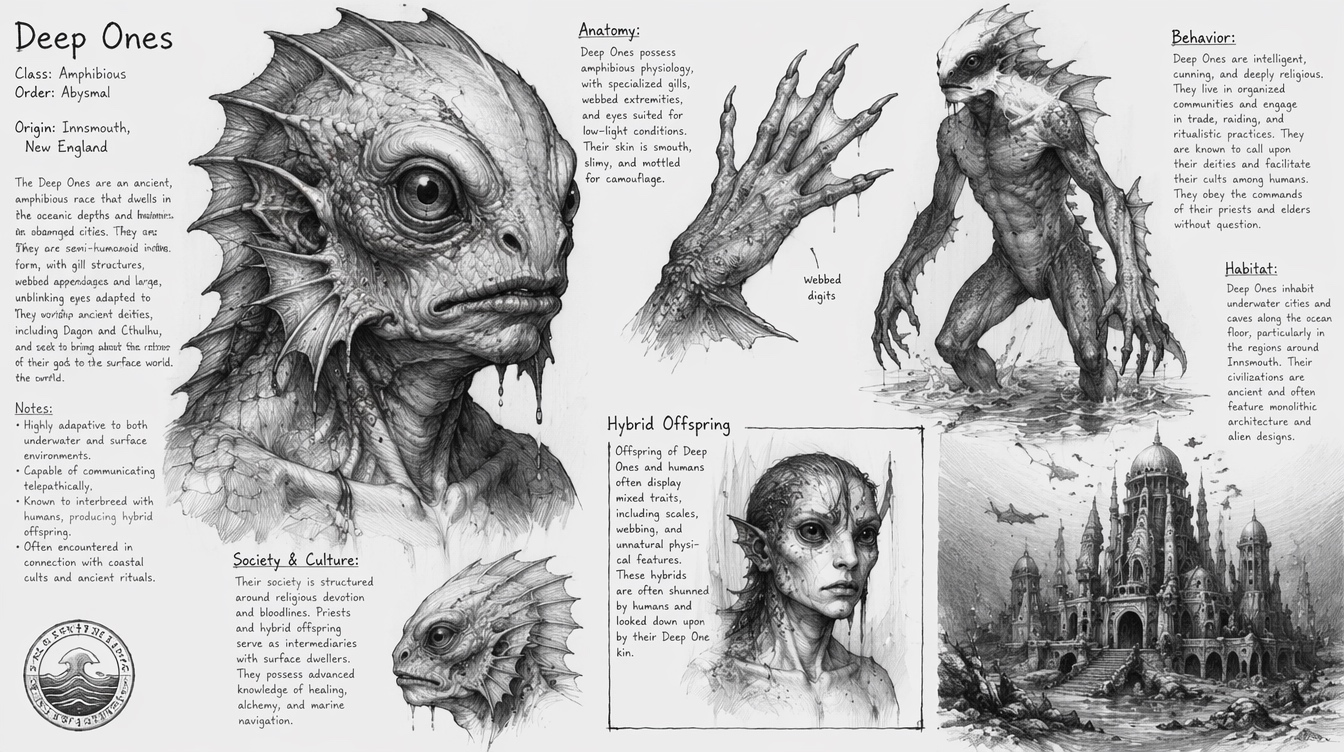
This level is closest to monster fiction. Shoggoths are engineered labor that rebelled; Deep Ones negotiate, breed, and worship through coastal communities; star-spawn connect Cthulhu to an older extraterrestrial lineage; byakhee, night-gaunts, and ghouls work as carriers, servants, or liminal inhabitants.

They are the practical interface of the Mythos. Through them, cosmic powers become family secrets, dockside economies, tools of travel, biological contamination, servant labor, and bodies seen too clearly in a basement, reef, tunnel, or dream road.

这一层最接近怪物小说。修格斯是被制造出的劳动生命并曾反叛;深潜者通过海岸社群交易、通婚与崇拜;克苏鲁星之眷族把 Cthulhu 连接到更古老的异星谱系;拜亚基、夜魇和食尸鬼则常作为载具、仆役或边界居民出现。

它们是神话体系最实际的接口。通过它们,宇宙力量会变成家族秘密、码头经济、旅行工具、生物污染、仆役劳动,以及在地下室、礁石、隧道或梦境道路中被看得太清楚的身体。

Miskatonic scholars and human contact visual reference
Rank VI / Human Contact Surface第六层 / 人类接触面
Cults, Scholars, Dreamers, and Witnesses 邪教徒、学者、梦者与见证者
Miskatonic scholars / cult networks / sailors / artists / isolated families

Human beings rarely command the Mythos. They translate, inherit, excavate, dream, misread, worship, or accidentally open doors. The Necronomicon and similar texts connect universities to cults; ports and ruined towns connect family history to nonhuman ancestry; dreams connect private experience to cosmic geography.

This is why the stories often use documents, letters, clippings, field notes, and confessions. Human knowledge arrives in fragments. The more complete the map becomes, the less useful ordinary human categories become: sanity, progress, religion, family, and even species identity begin to slip.

人类很少真正支配神话。人类更多是在翻译、继承、发掘、梦见、误读、崇拜,或意外打开门。《死灵之书》等文本把大学与邪教连接起来;港口与废镇把家族史连接到非人血统;梦境则把私人体验连接到宇宙地理。

这也是为什么这些故事常使用文献、书信、剪报、田野笔记和供词。人类知识总是以碎片形式抵达。地图越完整,普通的人类范畴越失效:理性、进步、宗教、家族,甚至物种身份都会开始松动。

Major Works主要代表作
The Call of Cthulhu cover
The Call of Cthulhu 克苏鲁的呼唤
1928

A layered investigation through sculpture, dreams, cult reports, and sea testimony reveals Cthulhu as a sleeping power whose scale breaks human confidence.

故事通过雕像、梦境、邪教报告与海上证词层层展开,揭示沉睡的 Cthulhu 是一种会击碎人类自信的巨大力量。

At the Mountains of Madness cover
At the Mountains of Madness 疯狂山脉
1936

An Antarctic expedition discovers ruins older than humanity and learns that Earth's history belongs to nonhuman civilizations before it belongs to us.

南极探险队发现早于人类的遗迹,并意识到地球历史首先属于非人文明,然后才轮到我们。

The Shadow over Innsmouth cover
The Shadow over Innsmouth 印斯茅斯之影
1936

A decaying seaside town hides a pact with the Deep Ones, turning genealogy, trade, and bodily change into a slow revelation of belonging.

一座衰败海港小镇隐藏着与深潜者的契约,把血统、交易和身体变化变成关于归属的缓慢揭示。

The Dunwich Horror cover
The Dunwich Horror 敦威治恐怖事件
1929

A rural family, forbidden books, and an invisible monstrosity connect backwoods isolation to Yog-Sothoth and the threat of opened thresholds.

乡村家族、禁书与不可见怪物,把偏僻山地的孤立感连接到 Yog-Sothoth 和被打开的门槛之危。

The Colour Out of Space cover
The Colour Out of Space 异星之彩
1927

A meteor brings a color outside human categories, poisoning land, bodies, and perception without ever becoming a creature humans can understand.

一颗陨石带来人类分类之外的颜色,污染土地、身体与感知,却始终不变成可被人理解的生物。

The Shadow Out of Time cover
The Shadow Out of Time 超越时间之影
1936

Mind exchange across geological ages reveals the Great Race of Yith and turns memory into evidence of a nonhuman archive of time.

跨越地质年代的意识交换揭示了 Yith 伟大种族,并把记忆变成非人时间档案的证据。

Life, Phases, and Historical Context生平、阶段与历史语境
Biography at a Glance生平概览

Lovecraft's life was geographically narrow but intellectually huge. He spent most of it in Providence, never achieved stable financial success through fiction, wrote an extraordinary volume of letters, and transformed private anxieties about science, history, class, and civilizational fragility into one of the most influential horror vocabularies of the twentieth century.

洛夫克拉夫特的人生在地理上相对狭窄,在智识上却极其庞大。他的大部分时间都生活在普罗维登斯,终其一生都没能靠小说获得稳定经济回报,却写下海量书信,并把自己对科学、历史、阶级与文明脆弱性的私人焦虑,转化成了二十世纪最有影响力的恐怖语言之一。

Birth出生20 August 1890, Providence, Rhode Island1890 年 8 月 20 日,普罗维登斯
Death去世15 March 1937, Providence; died of cancer after prolonged pain1937 年 3 月 15 日于普罗维登斯去世,病中长期承受疼痛
Primary identities主要身份Weird-fiction writer, essayist, critic, amateur journalist, letter-writer怪奇小说家、随笔作者、评论者、业余刊物作者、书信写作者
Key publisher核心发表平台Weird Tales, though many major works were underpaid, delayed, or rejected《Weird Tales》最重要,但不少代表作长期低稿酬、延迟发表或被拒
Chronology时间线

1890-1908Childhood, science, and breakdowns童年、科学兴趣与身体崩溃

Raised in Providence amid family decline, early bereavement, nightmares, and intense interest in astronomy, chemistry, and classical literature. Repeated health problems disrupted formal education and helped produce the isolated, self-educating pattern that shaped his adult life.

在普罗维登斯成长,经历家道衰落、亲人离世、反复噩梦,并早早迷上天文学、化学和古典文学。持续健康问题打断了正规教育,也塑造了他此后长期自我教育、相对封闭的生活模式。

1911-1918Letters, amateur press, first prose authority书信、业余刊物与早期散文权威感

Lovecraft's polemical letters to pulp magazines drew him into amateur journalism, where he found community, criticism, and a practical field for prose. Stories such as Dagon and The Tomb begin to show his movement from imitation toward a recognizably Lovecraftian pressure.

他写给通俗杂志的争论性来信把自己带进了业余刊物圈,也由此获得社群、批评环境和散文训练场。《达贡》《墓穴》等作品开始显出他从模仿走向“真正像洛夫克拉夫特”的过渡。

1919-1924Dream Cycle, grief, and opening outward梦境系、丧母与向外打开的阶段

After his mother's illness and death, Lovecraft became more socially active, met writers such as Frank Belknap Long, absorbed Lord Dunsany's influence, and produced the dreamlike fantasies that later came to be called the Dream Cycle. He also moved closer to the earliest firm Mythos stories.

在母亲患病并去世之后,他逐渐变得更外向,结识 Frank Belknap Long 等作家,吸收 Lord Dunsany 的影响,写出后来被归为“梦境系”的一批作品,同时也开始靠近真正意义上的早期神话文本。

1924-1926Marriage, New York, and pressure婚姻、纽约与压迫经验

Marriage to Sonia Greene took Lovecraft to New York. The city expanded his social circle but also intensified his class anxiety, xenophobia, alienation, and economic failure. This tension fed stories such as He and The Horror at Red Hook, while the outline of The Call of Cthulhu belongs to this period of crisis.

与 Sonia Greene 的婚姻把他带到纽约。纽约扩展了他的社交圈,但也放大了他的阶级焦虑、排外情绪、异化感与经济失败感。《He》《红钩区的恐怖》等作品,以及《克苏鲁的呼唤》的构想,都与这段危机时期密切相关。

1926-1937Providence return and mature mastery回归普罗维登斯与成熟高峰

Back in Providence, Lovecraft entered the period that produced his best-known work: The Call of Cthulhu, The Case of Charles Dexter Ward, At the Mountains of Madness, The Shadow over Innsmouth, and The Shadow Out of Time. He also became the central node of a correspondence network now called the Lovecraft Circle.

回到普罗维登斯后,洛夫克拉夫特进入真正的成熟高峰期,《克苏鲁的呼唤》《查尔斯·德克斯特·瓦德事件》《疯狂山脉》《印斯茅斯之影》《超越时间之影》等代表作都属于这一阶段;与此同时,他也成为后来所谓“洛夫克拉夫特圈子”的通信中心。

Writing Phases and Internal Map写作阶段与内部地图
Phase I: Poe-facing apprentice prose阶段一:面向 Poe 的学徒式散文

The earliest tales are heavily indebted to Edgar Allan Poe in sentence rhythm, confession structure, and enclosed psychological dread. These stories matter because they show Lovecraft learning how voice can be atmosphere, not just information.

最早期作品在句法节奏、告白结构与封闭心理恐惧方面都强烈依赖 Poe。它们的重要性在于,让人看见洛夫克拉夫特如何学会把“声音”本身变成氛围,而不只是信息载体。

Phase II: Dunsanian dream architecture阶段二:Dunsany 式梦境建筑

The Dream Cycle introduces drifting cities, dream geographies, archaic cadence, and a more explicitly lyrical mode. These stories are less “Mythos” in the popular sense, but essential for understanding how Lovecraft built wonder before he weaponized scale into horror.

梦境系引入了漂浮的城市、梦境地理、古雅语调和更明显的抒情模式。它们在大众印象中不如“神话系”显眼,却是理解洛夫克拉夫特如何先建构奇观、再把尺度武器化为恐怖的关键。

Phase III: Mythos and cosmic consolidation阶段三:神话系与宇宙观整合

This is where recurring books, cults, ruins, alien beings, and deep history begin to interlock. The key shift is not simply monster accumulation; it is the stabilization of a worldview in which humanity is provincial, knowledge is dangerous, and history is longer than moral narrative.

这一阶段里,反复出现的禁书、邪教、遗迹、异族与深时历史开始互相嵌合。真正的转折并不只是怪物变多,而是世界观被稳定下来:人类是局部的、知识是危险的、历史的长度远大于任何道德叙事。

Phase IV: Revision, ghostwriting, and network authorship阶段四:修订、代笔与网络式作者性

Lovecraft's output cannot be reduced to the signed stories alone. He revised and ghostwrote extensively for others, and many Mythos motifs circulated through this collaborative field. The page should therefore be read as a map of a literary system, not only a single author's isolated imagination.

如果只看署名短篇,就会低估洛夫克拉夫特。他为他人做了大量修订与代笔,而许多神话母题正是在这种合作网络中流动起来的。所以这页更应该被理解为一个文学系统的地图,而不只是单个作者的孤立想象。

Core Themes and Reading Keys核心主题与阅读钥匙
How to Read Lovecraft Beyond “Monsters”如何超越“怪物图鉴”去读洛夫克拉夫特
Theme主题 What it means含义 Where it appears典型出现方式
Cosmicism宇宙主义 / 宇宙冷漠 Humanity is not central, not protected, and not entitled to intelligibility.人类并不处于中心,也不被保护,更无权要求宇宙对自己可理解。 The Call of Cthulhu, At the Mountains of Madness, The Shadow Out of Time.《克苏鲁的呼唤》《疯狂山脉》《超越时间之影》。
Forbidden knowledge禁忌知识 Discovery is rarely liberating; it often destroys orientation, identity, or sanity.发现很少带来自由,反而往往摧毁方向感、身份感与理性结构。 Necronomicon lore, family archives, archaeological texts, witness documents.《死灵之书》、家族档案、考古文本、见证文件。
Deep time and prehuman history深时与前人类历史 History begins before us and may continue without us; we are latecomers to a layered planet.历史在我们之前就已开始,也完全可能在没有我们的情况下继续;人类只是这颗分层星球的后来者。 Ancient ruins, Antarctica, drowned cities, alien archives.古老遗迹、南极、沉没之城、异族档案。
Science under pressure受压的科学 Science is not the enemy; it is one of the tools that reveals how small we are.科学在这里承担揭示者的角色,让人看见自身的渺小。 Astronomy, non-Euclidean hints, biology, geology, pseudo-scientific framing.天文学、非欧几何暗示、生物学、地质学与伪科学式叙述框架。
Civilizational decline文明衰败 Cities, families, and cultures are often portrayed as decaying shells over older violence or older occupants.城市、家族与文明常被写成衰败外壳,其下覆盖着更古老的暴力或更古老的居住者。 Innsmouth, Red Hook, crumbling houses, ancestral corruption, exhausted New England.印斯茅斯、红钩区、衰败宅邸、祖谱腐蚀、疲惫的新英格兰。
Places, Books, and Recurring Connectors地点、禁书与反复出现的连接器
  • Arkham, Innsmouth, Dunwich, and Kingsport extend beyond settings; they are tonal machines that turn New England into memory, rot, folklore, and geologic unease.阿卡姆、印斯茅斯、敦威治、金斯波特并不只是背景地名,而是把新英格兰加工成记忆、腐朽、民俗与地质不安的“情绪机器”。
  • The Necronomicon matters less as a single object than as a model of textual contamination: scholarship and cult practice stop being cleanly separate.《死灵之书》的意义并不只在于它是一本书,而在于它构成了一种文本污染模型:学术与邪教实践不再能被清楚区分。
  • Dreamlands, R'lyeh, Antarctic ruins, and subterranean cities create a geography where mind, map, and history are permanently unstable.梦境诸地、R'lyeh、南极遗迹与地下古城共同构成一种地理学:心灵、地图与历史在其中始终处于不稳定状态。
  • Documents, clippings, testimony, diaries, and pseudo-academic summaries are not decorative; they are the narrative form most suited to a truth that only arrives in fragments.文献、剪报、证词、日记与伪学术摘要是最适合承载“碎片化真相”的叙事形式,并非装饰。
Lovecraft Circle, Mythos Expansion, and Canon Problems洛夫克拉夫特圈子、神话扩展与正典问题
From private network to shared universe从私人通信网络到共享宇宙

Lovecraft's fiction already behaves like a distributed archive. He exchanged ideas, names, invented books, and cosmological hints with writers such as Clark Ashton Smith, Robert E. Howard, Frank Belknap Long, Robert Bloch, Henry Kuttner, and others. That circulation of references made the Mythos feel larger than any single bibliography almost from the beginning.

洛夫克拉夫特的小说本身就像一个分布式档案系统。他与 Clark Ashton Smith、Robert E. Howard、Frank Belknap Long、Robert Bloch、Henry Kuttner 等人不断交换名字、禁书、设定和宇宙学暗示。正是这种持续流动的互文关系,让克苏鲁神话从一开始就显得大于任何单一作品目录。

Lovecraft's own attitude洛夫克拉夫特本人的态度He did not design a rigid canonical system; he jokingly called the network "Yog-Sothothery".他并未构造一套刚性正典,甚至曾戏称这种网络为 “Yog-Sothothery”。
Why later readers get confused后世读者为何常混淆Because later editors and writers retrofitted structure onto a body of work originally held together by mood, recurrence, and worldview.因为后来的编辑和作者试图给原本依靠情绪、复现与世界观维系的体系,重新套上结构化框架。
Derleth problemDerleth 问题August Derleth preserved and expanded Lovecraft's legacy, but also recast it into a more moralized cosmology of good and evil that many scholars consider un-Lovecraftian.August Derleth 一方面保存并扩展了洛夫克拉夫特遗产,另一方面也把它重写成更接近善恶对抗的宇宙图式,许多研究者认为这并不真正符合洛夫克拉夫特原意。
Controversy and Critical Reading争议与批判性阅读
What cannot be skipped哪些问题不能回避

Any serious page on Lovecraft must address the tension between aesthetic greatness and ideological ugliness. His racism, xenophobia, class snobbery, and cultural panic are not marginal trivia. They are visibly entangled with parts of his fiction, especially when contamination, hybrid ancestry, immigration anxiety, or urban disorder become horror triggers.

任何严肃的洛夫克拉夫特专题页,都必须正面处理“美学影响力”与“思想丑陋性”之间的张力。他的种族主义、排外倾向、阶级傲慢与文化恐慌是和作品内部某些恐怖机制直接纠缠在一起,尤其是在“污染”“混血血统”“移民焦虑”“城市失序”等成为恐怖触发器的时候,并非边缘八卦。

  • This does not make the fiction unreadable, but it does make uncritical admiration intellectually weak.这并不意味着作品因此不可读,但意味着不加批判的崇拜在智识上站不住脚。
  • Modern scholarship and later creators often read Lovecraft against himself: preserving cosmic horror while rejecting the racial hierarchies through which he sometimes framed fear.现代研究与后继创作者常常是在“逆着洛夫克拉夫特去读洛夫克拉夫特”:保留宇宙恐怖的力量,同时拒绝他用来组织恐惧的种族等级框架。
  • His late-life political changes complicate the picture somewhat, but they do not erase the damage or the record.他晚年的政治变化确实让图景变得稍微复杂,但并不能抹去既有问题与历史记录。
A mature reading position is double: take the imaginative architecture seriously, and take the prejudice seriously.更成熟的阅读位置应该是双重的:既认真对待他的想象建筑,也认真对待其中的偏见结构。
Legacy, Adaptation, and Why He Still Matters遗产、改编与他为何仍然重要
Literary and philosophical afterlife文学与哲学层面的后生命

Lovecraft moved from pulp marginality into the modern canon through scholars, editors, critics, and the sheer durability of his conceptual vocabulary. Terms such as Lovecraftian horror, cosmic horror, and even philosophical discussions of anti-anthropocentrism now circulate far beyond genre fandom.

洛夫克拉夫特从通俗杂志边缘一路进入现代文学经典秩序,依靠的是研究者、编辑、批评者,以及他那套概念词汇本身的持久性。今天,“洛夫克拉夫特式恐怖”“宇宙恐怖”,甚至围绕反人类中心主义的哲学讨论,早已超出类型文学圈层。

Games, film, comics, music游戏、电影、漫画与音乐

Tabletop games such as Call of Cthulhu, board games such as Arkham Horror, numerous video games, heavy metal and extreme music, comics, and directors from John Carpenter to Guillermo del Toro all helped translate Lovecraft into mass culture. Often these adaptations simplify his themes, but they also prove how portable his atmosphere is.

《克苏鲁的呼唤》桌游、《阿卡姆惊魂》桌面游戏、众多电子游戏、重金属与极端音乐、漫画,以及从 John Carpenter 到 Guillermo del Toro 的导演,都把洛夫克拉夫特转译进了大众文化。很多改编会简化他的主题,但也反过来证明了他的氛围为何如此可迁移。

Why Lovecraft always opens outward为什么洛夫克拉夫特总让人越读越想往下追

It is hard to draw a final boundary around Lovecraft because he is simultaneously a writer, a body of texts, a shared fictional system, a correspondence archive, a field of criticism, and an unresolved cultural controversy. Any one of those layers can lead you further outward.

你很难替洛夫克拉夫特画出一条真正的终点线,因为他同时是一个作家、一整批作品、一个不断扩展的虚构体系、一座庞大的书信档案,也是持续至今的研究对象和文化争议。无论从哪一层继续往下看,后面总还有东西会牵着你读下去。

Reference Gateways参考入口