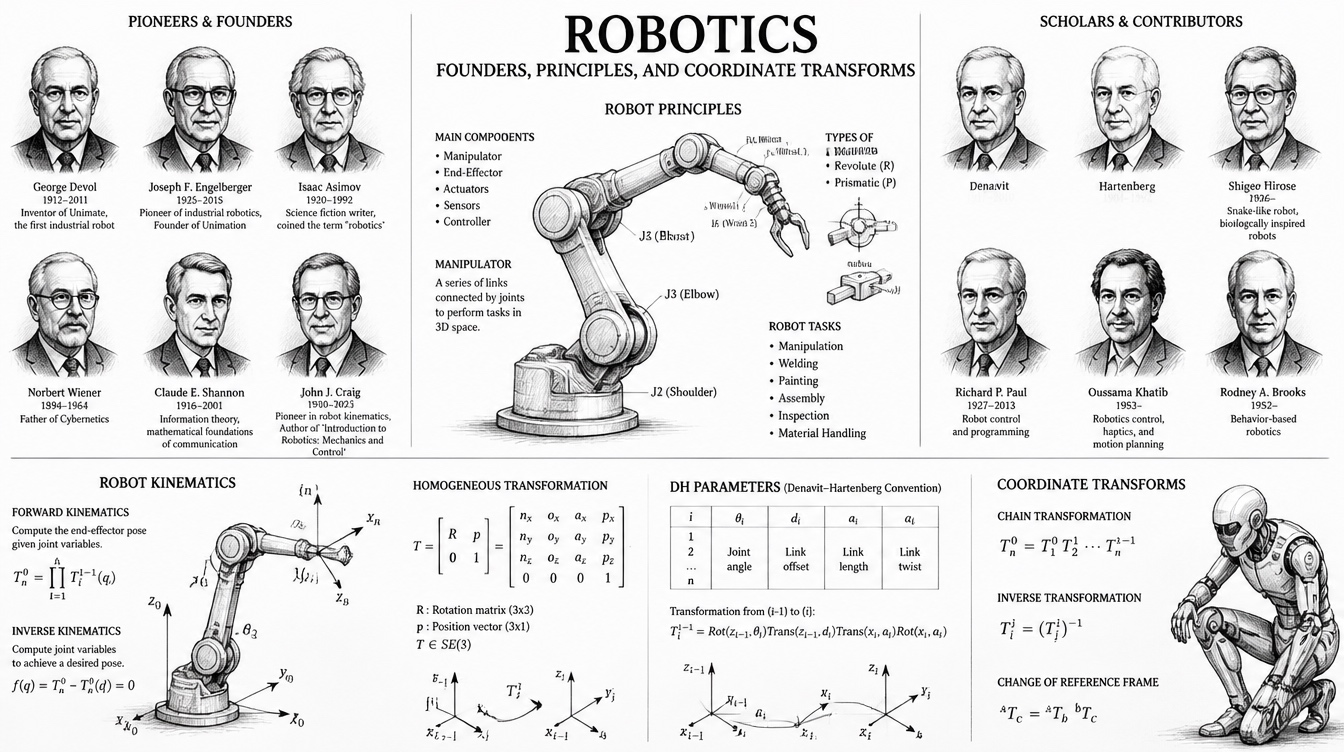
Robotics and Its Core Principles机器人学及原理
Embodiment / manipulation / autonomy具身 / 操作 / 自主Kinematics / Dynamics / Control / PerceptionCompanies + end effectors + humanoids公司 + 末端执行器 + 人形机器人
Robotics studies embodied cyber-physical systems: machines whose intelligence is both written in software and constrained by geometry, mass, friction, compliance, actuation limits, sensing uncertainty, safety requirements, and the economics of deployment. A robot must transform perception into a state estimate, transform that estimate into a plan, and transform the plan into physical motion while the world pushes back through contact, delay, noise, and unexpected change.
That makes robotics a meeting point between mechanical engineering, electrical drives, control theory, computer vision, estimation, motion planning, AI, materials, ergonomics, manufacturing, and operations research. The central academic question concerns reliable action under constraints, well beyond movement alone: with limited torque, imperfect sensors, uncertain objects, people nearby, changing tasks, maintainable software, and a measurable safety envelope.
A robot is intelligence with a body. Every algorithm is filtered through kinematic reach, inertia, actuator bandwidth, structural stiffness, payload, power, thermal limits, and the physical contact between tool and world.
Autonomy is a closed loop from sensing to decision to action. It may be a fixed industrial sequence, a human-supervised collaborative task, or an adaptive system that estimates state, plans alternatives, and recovers from disturbance.
Robot design begins with the task ecology: object variation, cycle time, workspace layout, tooling, safety standard, maintenance skill, data availability, and business value. A welding robot, surgical robot, warehouse AMR, quadruped inspector, and humanoid all optimize different tradeoffs.
Water clocks, mechanical birds, and programmable automata show that humans imagined self-moving machines long before electronics.
Karel Capek's play R.U.R. popularized the word robot, linking robots with labor, automation, and social anxiety.
Cybernetics, feedback control, servomechanisms, and early AI established the theoretical base for sensing and control.
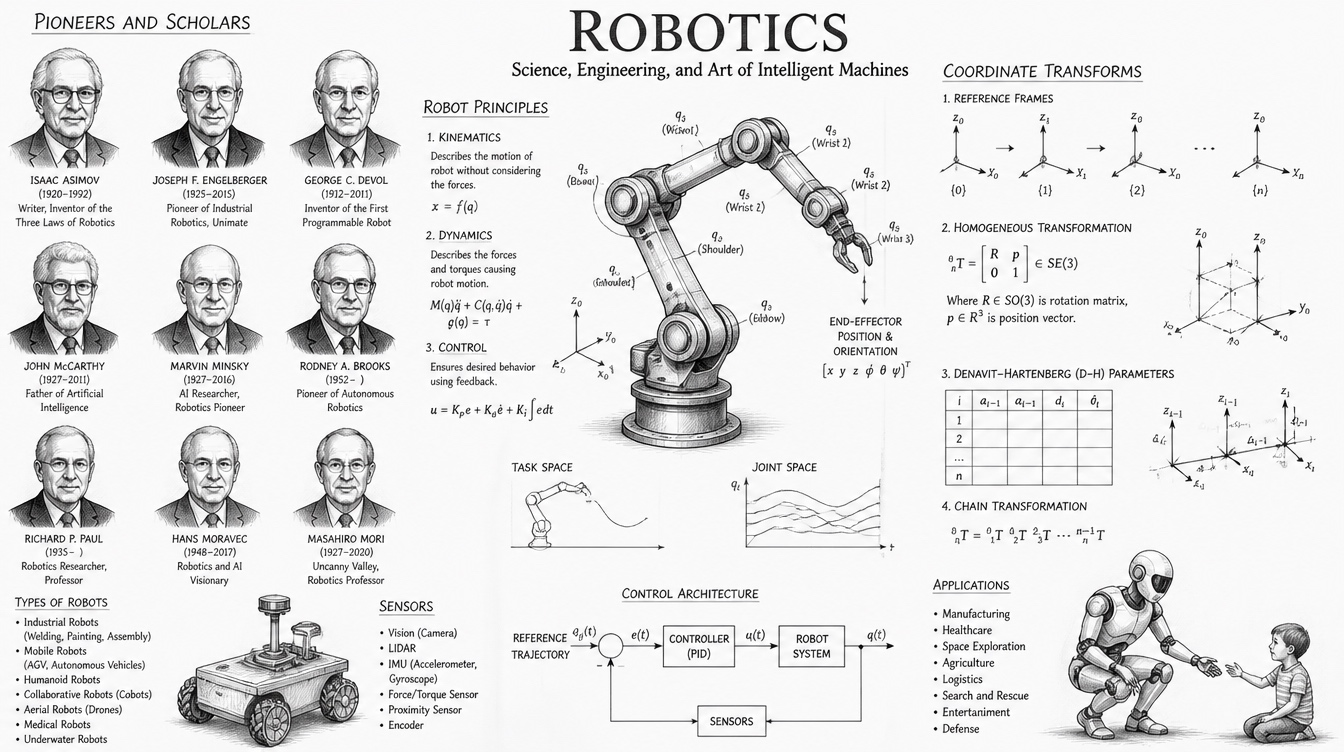
George Devol patented the programmable manipulator; Joseph Engelberger commercialized Unimate, the first industrial robot used by General Motors.
Robot arms, CNC, welding, painting, mobile robots, and academic robotics labs expanded rapidly.
SLAM, probabilistic robotics, service robots, surgical robots, UAVs, and warehouse automation matured.
Collaborative robots, deep learning perception, legged robots, soft grippers, and autonomous vehicles became major fronts.
Foundation models, simulation-to-real transfer, humanoids, robot learning, and general-purpose manipulation became central debates.
| Name | Role | Contribution |
|---|---|---|
| Al-Jazari | Automata pioneer | Designed programmable mechanical devices, clocks, and automated servants. |
| Karel Capek | Writer | Popularized the term robot in R.U.R. |
| Norbert Wiener | Cybernetics | Established feedback, communication, and control concepts for machines and organisms. |
| Isaac Asimov | Science fiction / ethics | Shaped public robot ethics through the Three Laws of Robotics. |
| George Devol | Industrial robot inventor | Invented the programmable manipulator behind Unimate. |
| Joseph Engelberger | Industrial robotics founder | Commercialized industrial robots and helped build the robotics industry. |
| Jacques Denavit & Richard Hartenberg | Kinematics | Created DH parameters for serial-link robot modeling. |
| Oussama Khatib | Control / manipulation | Operational space control, robot motion, human-centered robotics. |
| Marc Raibert | Legged robotics | Dynamic balance and legged robots; founder of Boston Dynamics. |
| Rodney Brooks | Behavior-based robotics | Subsumption architecture; iRobot co-founder; practical robot autonomy. |
| Sebastian Thrun | Probabilistic robotics | SLAM, autonomous vehicles, probabilistic perception and control. |
| Takeo Kanade | Computer vision / robotics | Vision, autonomous systems, manipulation, and perception algorithms. |
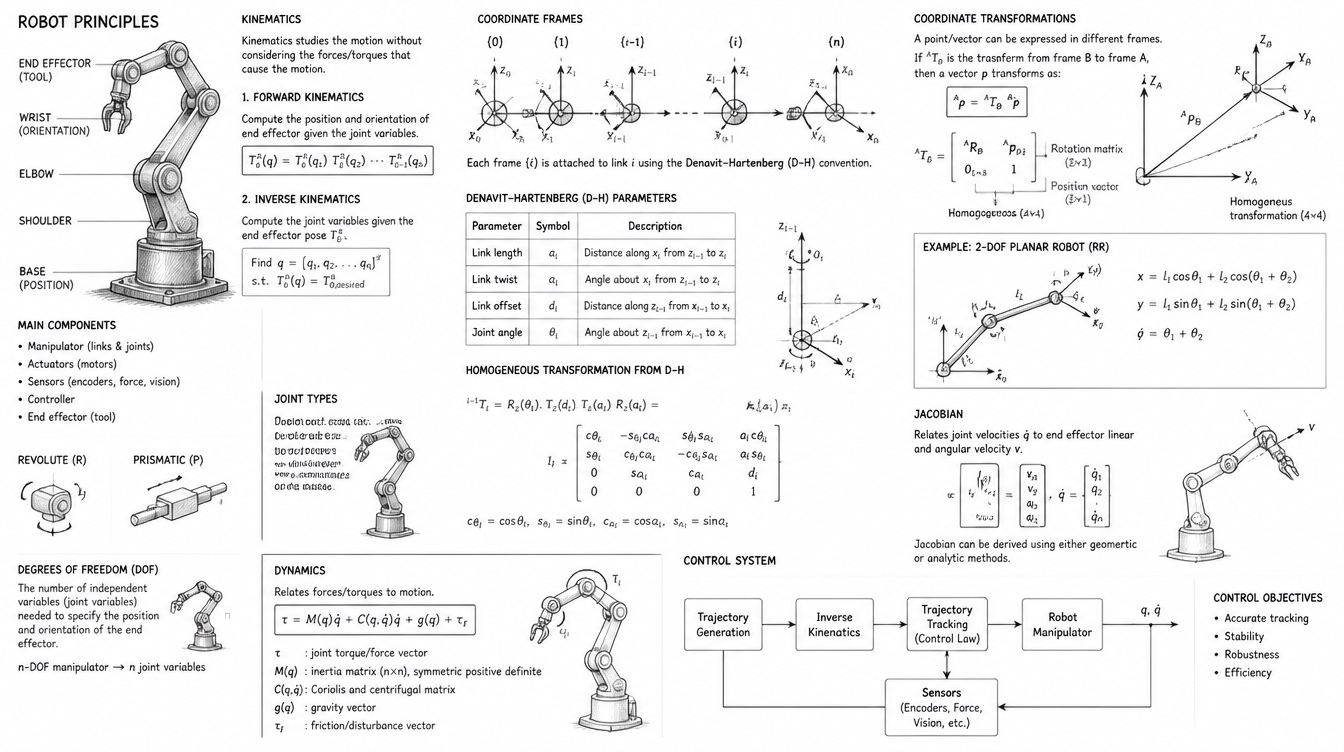
Rigid-body pose maps coordinates between frames.
Joint coordinates produce end-effector pose.
Denavit-Hartenberg parameters encode serial manipulator geometry.
Joint velocity maps to task-space linear and angular velocity.
External wrench at the end effector maps to joint torques.
Robot motion depends on inertia, Coriolis/centrifugal terms, gravity, friction, actuation, and contact.
Basic feedback control for position, velocity, force, and process loops.
Model-based control linearizes manipulator dynamics around a desired trajectory.
Controls dynamic relation between force and motion for contact-rich tasks.
Quintic polynomials provide smooth position, velocity, and acceleration profiles.
Probabilistic state estimation fuses motion and sensor evidence.
Simultaneous localization and mapping estimates robot trajectory and environment map.
Motion planning searches feasible, collision-free, low-cost actions.
A grasp is stable when contact forces can produce needed object wrenches within friction constraints.
Industrial arms, cobots, controllers, welding, painting, palletizing, and automation cells.
Official siteIndustrial robots, automotive automation, mobile platforms, and system integration.
Official siteIndustrial robots for welding, handling, painting, packaging, and assembly.
Official siteIndustrial robot arms for manufacturing, logistics, and medical/pharma automation.
Official siteHigh-speed, cleanroom, pharma, food, electronics, and precision automation robots.
Official siteCollaborative robot pioneer for flexible automation and small-batch production.
Official siteVision-enabled collaborative robots for assembly, inspection, and machine tending.
Official siteCollaborative robots for manufacturing, food service, logistics, and research.
Official site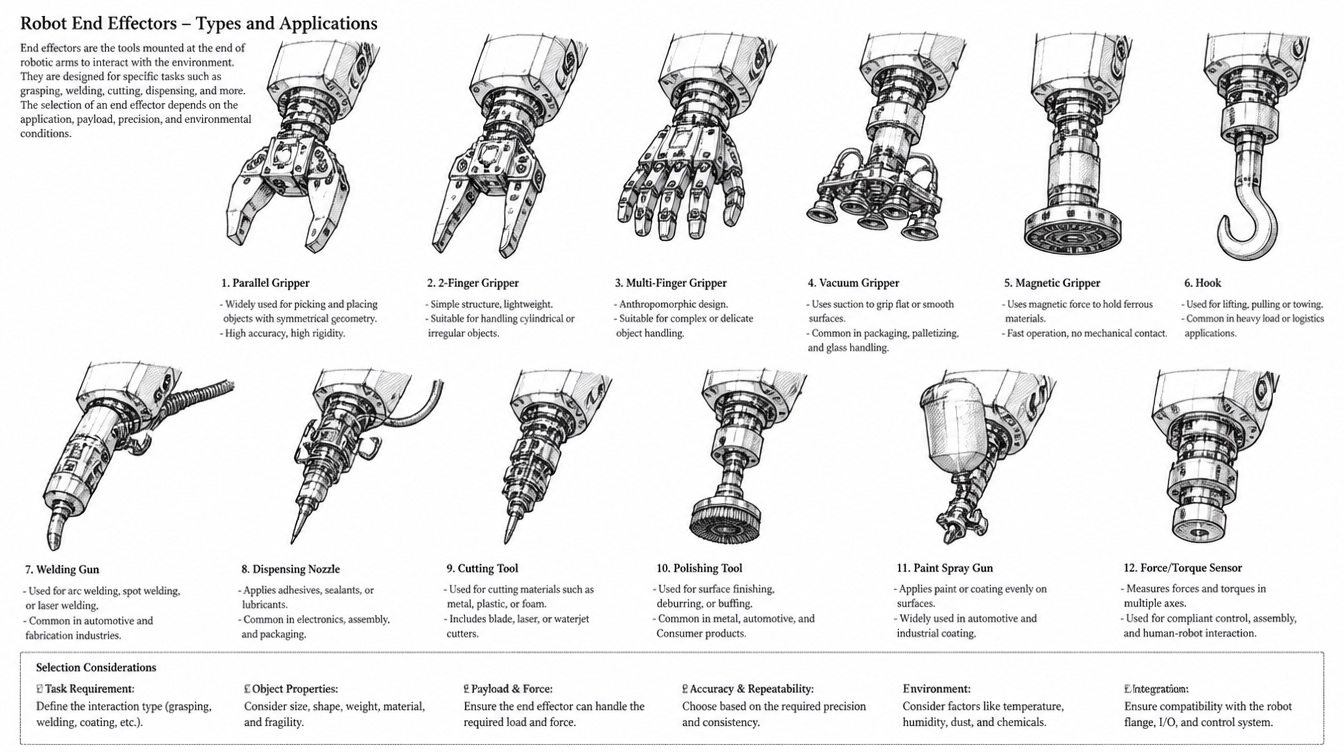
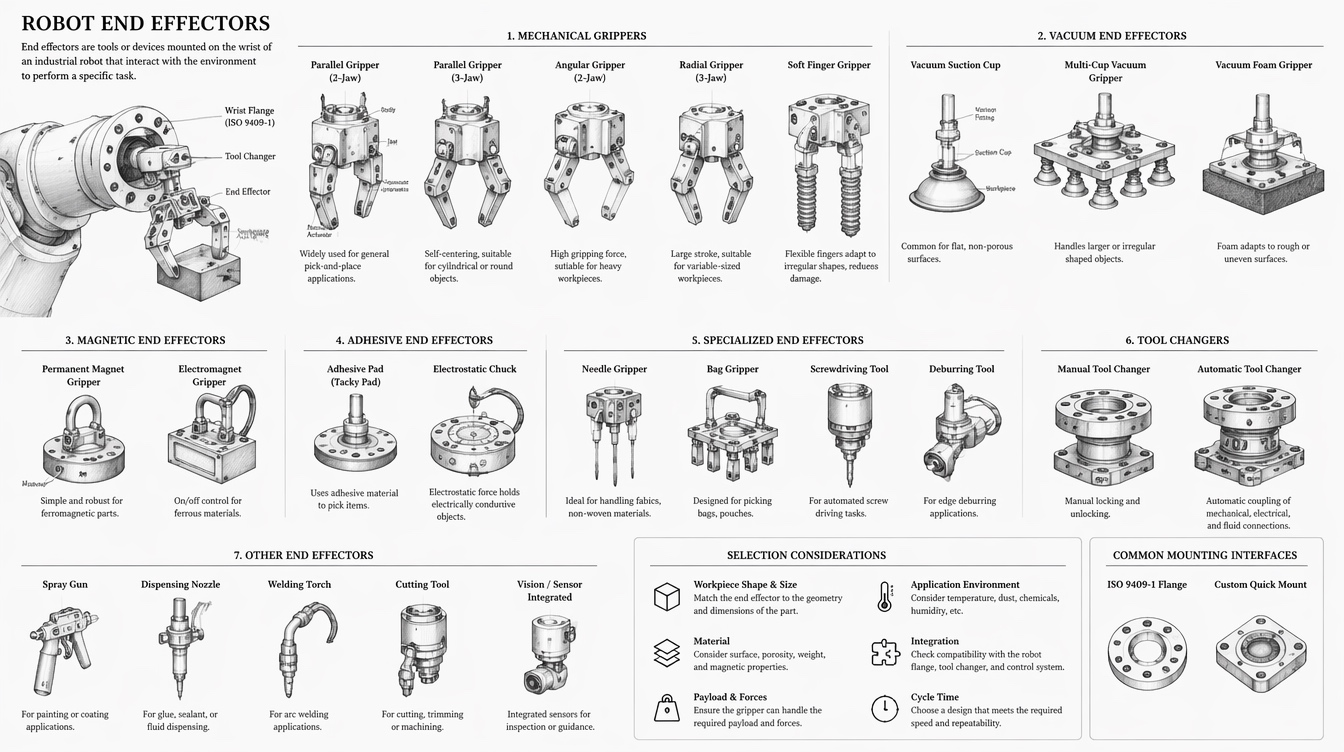
The end effector is where abstract robot motion becomes useful physical work. Selecting a gripper or process tool is therefore a decision about contact physics: object shape, surface material, allowable force, contamination, cycle time, payload, sensing, tool changing, and failure recovery all matter. A technically excellent arm can still fail if the tool cannot tolerate real object variation.
| Type | Function | Typical use | Main companies |
|---|---|---|---|
| Parallel gripper | Two-finger mechanical grasp | Pick-and-place, machine tending | SCHUNK, Robotiq, Zimmer Group |
| Vacuum cup | Suction grasp on surfaces | Packaging, sheet metal, boxes | Piab, SMC, Schmalz |
| Magnetic gripper | Magnetic holding force | Ferrous metal parts | Schmalz, SMC |
| Soft gripper | Compliant deformation | Food, fragile, irregular objects | Soft Robotics, Festo |
| Tool changer | Automatic tool exchange | Flexible cells, welding, inspection | ATI Industrial Automation, OnRobot |
| Force/torque sensor | Measure contact wrench | Assembly, polishing, research | ATI, OnRobot |
| Welding torch / spindle | Process tool | Welding, cutting, machining | Fronius, ATI |
Autonomous inspection robots combine locomotion, thermal cameras, acoustic sensors, gas detection, lidar mapping, and remote operations. Their value is repeatable data collection in places where human inspection is dangerous, expensive, or too infrequent for predictive maintenance.
ANYboticsQuadruped robots commercialize dynamic balance, terrain adaptation, whole-body control, and robust perception. Compared with wheeled AMRs, they sacrifice mechanical simplicity but gain access to stairs, rubble, outdoor plants, mines, and sites designed for human legs.
Boston DynamicsMedical and surgical robots emphasize accuracy, tremor filtering, ergonomics, sterile workflow, and regulatory validation. They translate human intent through precise instruments, constrained motion, high-quality visualization, and repeatable clinical procedure design.
IntuitiveAMR logistics robots combine localization, fleet management, obstacle avoidance, scheduling, charging strategy, and integration with warehouse or hospital systems. The complexity is system-level: many robots must move safely among people while still meeting throughput targets.
MiRDrone robots use lightweight structures, flight control, visual-inertial estimation, mission planning, and payload integration. They turn robotics into a three-dimensional sensing platform, but endurance, wind, regulation, obstacle avoidance, and data quality remain core constraints.
DJIUnderwater robots operate where GPS is unavailable, communication is limited, pressure is high, and hydrodynamic forces dominate. They rely on tethered operation, acoustic navigation, cameras, sonar, buoyancy control, and corrosion-resistant design.
Blue RoboticsService robots bring robotics into semi-structured human environments. They must handle navigation, interaction, hygiene, charging, maintenance, and user trust; success depends as much on service design and reliability as on algorithms.
iRobotWearable robotic systems for rehabilitation, industry, and mobility assistance.
Ekso BionicsHumanoid robots place actuators, sensors, batteries, computation, and control in a human-like body. They are attractive because many human environments already assume legs, arms, hands, vision height, doors, stairs, tools, and social interaction. They are difficult because whole-body balance, dexterous manipulation, power density, safety, cost, and reliability must be solved together.
| Dimension | Traditional industrial robot | Humanoid robot |
|---|---|---|
| Workspace | Structured cell with fixed tools and fixtures. | Human environments with stairs, doors, clutter, and varied objects. |
| Mobility | Usually fixed-base or wheeled. | Bipedal or whole-body mobile manipulation. |
| Control | Precise repeatable trajectories. | Balance, locomotion, manipulation, perception, and safety at once. |
| Value | High speed, accuracy, uptime, and ROI in known tasks. | General-purpose labor potential in spaces built for humans. |
| Risk | Integration cost and downtime. | Reliability, battery, safety certification, dexterity, and unit economics. |
General-purpose humanoid robot development tied to Tesla's AI and manufacturing ecosystem.
Official siteHumanoid and service robots with education, commercial, and industrial applications.
Official site机器人学研究的是具身的赛博物理系统:机器人的智能不只存在于软件里,也被几何结构、质量、摩擦、柔顺性、驱动极限、传感误差、安全要求和部署成本共同约束。机器人必须把感知转换成状态估计,把状态估计转换成计划,再把计划转换成真实运动;而真实世界会用接触、延迟、噪声和突发变化不断打断这个过程。
因此,机器人学是机械工程、电气驱动、控制理论、计算机视觉、状态估计、运动规划、AI、材料、人机工程、制造和运筹优化的交汇点,并非单一学科。它的核心问题是机器能否在现实约束下可靠行动,而非单纯能不能动:扭矩有限、传感不完美、物体不确定、旁边有人、任务会变、软件要可维护、安全边界要可证明,最终还要有实际部署价值。
机器人是有身体的智能。任何算法最终都要经过运动学可达范围、惯量、执行器带宽、结构刚度、负载、功耗、热限制,以及工具和世界之间的真实接触来检验。
自主性是从感知到决策再到动作的闭环。它可以是固定的工业节拍,可以是人监督下的协作任务,也可以能够估计状态、规划替代路径并从扰动中恢复的自适应系统。
机器人设计从任务生态开始:物体变化、节拍要求、工作空间、末端工具、安全标准、维护能力、数据可得性和商业价值都会影响方案。焊接机器人、手术机器人、仓储 AMR、四足巡检机器人和人形机器人优化的是完全不同的取舍。
水钟、机械鸟和可编程自动装置说明,人类很早就想象自运动机器。
Karel Capek 的戏剧 R.U.R. 普及 robot 一词,把机器人和劳动、自动化、社会焦虑联系起来。
控制论、反馈控制、伺服机构和早期 AI 奠定感知与控制理论基础。
George Devol 申请可编程机械臂专利;Joseph Engelberger 将 Unimate 商业化,用于通用汽车生产线。
机械臂、CNC、焊接、喷涂、移动机器人和大学机器人实验室快速发展。
SLAM、概率机器人、服务机器人、手术机器人、无人机和仓储自动化成熟。
协作机器人、深度学习感知、足式机器人、软体夹爪和自动驾驶成为前沿。
基础模型、仿真到现实迁移、人形机器人、机器人学习和通用操作成为核心议题。
| 人物 | 角色 | 贡献 |
|---|---|---|
| Al-Jazari | 自动机械先驱 | 设计可编程机械装置、时钟和自动侍者。 |
| Karel Capek | 作家 | 在 R.U.R. 中普及 robot 一词。 |
| Norbert Wiener | 控制论 | 建立机器与生物中的反馈、通信和控制概念。 |
| Isaac Asimov | 科幻 / 伦理 | 通过机器人三定律影响公众机器人伦理想象。 |
| George Devol | 工业机器人发明者 | 发明 Unimate 背后的可编程机械臂。 |
| Joseph Engelberger | 工业机器人之父 | 推动工业机器人商业化,建立机器人产业。 |
| Denavit & Hartenberg | 运动学 | 提出串联机械臂建模的 DH 参数。 |
| Oussama Khatib | 控制 / 操作 | 操作空间控制、机器人运动和以人为中心的机器人研究。 |
| Marc Raibert | 足式机器人 | 动态平衡和足式机器人;Boston Dynamics 创始人。 |
| Rodney Brooks | 行为式机器人 | 包容架构、iRobot 联合创始人、实用自主机器人。 |
| Sebastian Thrun | 概率机器人 | SLAM、自动驾驶、概率感知与控制。 |
| Takeo Kanade | 计算机视觉 / 机器人 | 视觉、自主系统、操作和感知算法。 |
刚体位姿用于在坐标系之间映射点和方向。
关节坐标决定末端执行器位姿。
Denavit-Hartenberg 参数描述串联机械臂几何结构。
关节速度映射为任务空间线速度和角速度。
末端外力/力矩映射为关节力矩。
机器人运动由惯性、科氏/离心项、重力、摩擦、驱动和接触共同决定。
位置、速度、力和工艺控制中最常见的反馈控制形式。
基于模型的控制围绕目标轨迹线性化机械臂动力学。
控制接触任务中力与运动的动态关系。
五次多项式可提供平滑的位置、速度和加速度曲线。
概率状态估计融合运动模型与传感器证据。
同步定位与建图同时估计机器人轨迹和环境地图。
运动规划搜索可行、无碰撞且低成本的行动。
当接触力能在摩擦约束内产生所需物体力旋量时,抓取才稳定。
末端执行器是机器人把抽象运动转化为有效物理工作的地方。选择夹爪或工艺工具,本质上是在选择一种接触物理方案:物体形状、表面材料、允许夹持力、污染风险、节拍、负载、传感、换工具策略和失败恢复都必须一起考虑。机械臂本体再优秀,如果工具不能适应真实物体变化,整套系统仍然会失败。
| 类型 | 作用 | 典型用途 | 主要公司 |
|---|---|---|---|
| 平行夹爪 | 两指机械抓取 | 抓取放置、机床上下料 | SCHUNK, Robotiq, Zimmer Group |
| 真空吸盘 | 利用吸力抓取表面 | 包装、板材、纸箱 | Piab, SMC, Schmalz |
| 磁力夹具 | 磁力吸附 | 铁磁金属零件 | Schmalz, SMC |
| 软体夹爪 | 柔顺变形抓取 | 食品、易碎、异形物体 | Soft Robotics, Festo |
| 快换工具 | 自动更换末端工具 | 柔性单元、焊接、检测 | ATI Industrial Automation, OnRobot |
| 力/力矩传感器 | 测量接触力旋量 | 装配、抛光、研究 | ATI, OnRobot |
| 焊枪 / 主轴 | 工艺工具 | 焊接、切割、加工 | Fronius, ATI |
自主巡检机器人把移动能力、热成像、声学传感、气体检测、激光建图和远程运维组合起来。它们通过移动能力,在危险、昂贵或人工巡检频率不足的场景中,稳定采集可用于预测性维护的数据。
ANYbotics四足机器人把动态平衡、地形适应、全身控制和鲁棒感知推向工程化。与轮式 AMR 相比,它们牺牲了机械简单性,却获得了进入楼梯、碎石、户外工厂、矿区和以人类双腿为尺度设计空间的能力。
Boston Dynamics医疗与手术机器人强调精度、震颤过滤、人体工学、无菌流程和监管验证。它们是通过精密器械、受约束运动、高质量视觉和可重复流程,把人的意图转化为更稳定的临床操作,并非简单替代医生。
Intuitive水下机器人工作在没有 GPS、通信受限、压力高且水动力显著的环境中。它们依赖系缆操作、声学导航、相机、声呐、浮力控制和抗腐蚀设计,服务于水下巡检、科研和海洋基础设施运维。
Blue Robotics人形机器人把执行器、传感器、电池、计算和控制塞进接近人类的身体结构中。它们有吸引力,是因为很多人类环境已经默认腿、手臂、手、视线高度、门、楼梯、工具和社会互动。难点在于全身平衡、灵巧操作、功率密度、安全、成本和可靠性必须一起解决。
| 维度 | 传统工业机器人 | 人形机器人 |
|---|---|---|
| 工作空间 | 结构化单元,固定工具和夹具。 | 有楼梯、门、杂物和多样物体的人类环境。 |
| 移动方式 | 通常固定基座或轮式。 | 双足或全身移动操作。 |
| 控制 | 精确、可重复的轨迹。 | 平衡、移动、操作、感知和安全同时处理。 |
| 价值 | 在已知任务中高速、高精度、高稼动率和 ROI。 | 在为人类建造的空间中具备通用劳动潜力。 |
| 风险 | 集成成本和停机时间。 | 可靠性、电池、安全认证、灵巧性和单位经济性。 |