The Origin, Present, and Future of the Universe宇宙的起源、现在和未来
Big Bang / expansion / cosmic fate大爆炸 / 宇宙膨胀 / 宇宙终局Cosmology / Planetary Science / Black Holes / QuasarsMathJax formulasMathJax 公式
The universe is not simply "everything that exists" in a poetic sense. In physics and cosmology, it is the total evolving system of spacetime, matter, radiation, quantum fields, large-scale structure, and the dynamical laws through which these interact. To speak of the universe seriously means speaking at many scales at once: subatomic particles, stars, galaxies, clusters, dark matter halos, black holes, interstellar chemistry, planetary surfaces, and the observational horizon beyond which current light has not yet reached us.
A modern account of the universe therefore sits at the intersection of cosmology, astrophysics, planetary science, relativity, quantum theory, plasma physics, spectroscopy, geophysics, instrumentation, and computation. The subject is both conceptually grand and technically disciplined. It asks where the universe came from, how structure formed, why physical constants take the values they do, whether life is common or rare, and how the cosmos may end.
Professional cosmology also works under a severe epistemic constraint: we observe the universe from one tiny location, during one narrow era, through signals limited by finite light speed, detector precision, atmospheric windows, instrument calibration, and model assumptions. That makes cosmology unusually inferential. Cosmology reconstructs the universe from spectra, redshift catalogs, anisotropies, lensing maps, gravitational waves, abundances, and long chains of statistical reasoning.
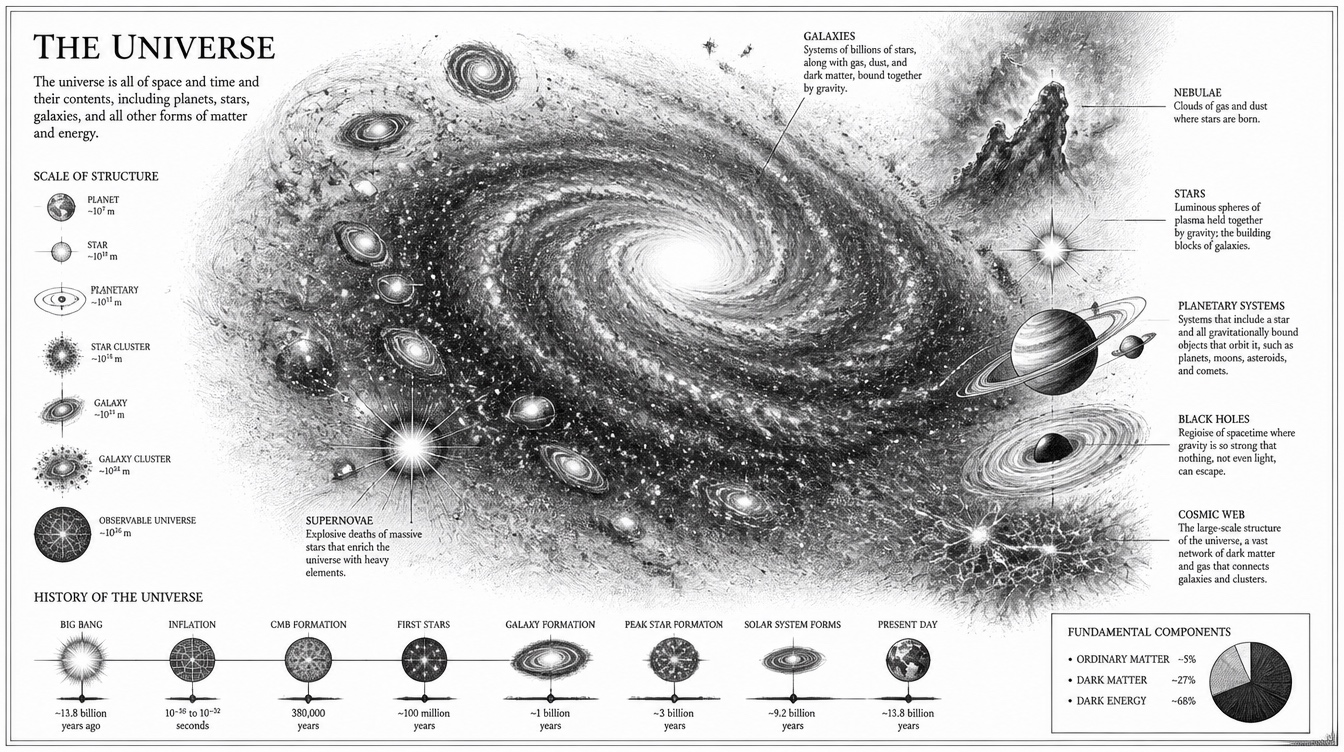
The universe includes spacetime itself, not only the objects placed inside it. It contains baryonic matter such as stars, planets, gas, dust, and biological chemistry; non-baryonic components such as dark matter; radiation such as the cosmic microwave background; and a dark-energy-like component associated with the accelerating expansion of space.
The geometric arena described by relativity, where distance, time, curvature, and gravity are inseparable.
Ordinary matter forms atoms, molecules, stars, planets, and observers, but it is only a minority of the total cosmic energy budget.
Known indirectly through gravitational effects on galaxies and structure formation; still not identified at the particle level.
The name given to the phenomenon driving late-time cosmic acceleration; one of the largest unresolved problems in fundamental physics.
Professional cosmology is not only descriptive; it is equation-driven. A large part of the modern picture comes from combining relativistic geometry, fluid dynamics, thermodynamics, radiative transfer, and statistical inference. The formulas below provide several recognizable structural anchors within a much larger theory.
This metric models a homogeneous and isotropic universe, with scale factor \(a(t)\) encoding cosmic expansion and \(k\) representing spatial curvature.
The expansion rate depends on total energy density, curvature, and cosmological constant. This is one of the backbone equations of standard cosmology.
Cosmological redshift measures how much the universe has expanded between emission and observation.
Critical density defines the natural reference scale used to express \(\Omega_m\), \(\Omega_\Lambda\), and other cosmic density fractions.
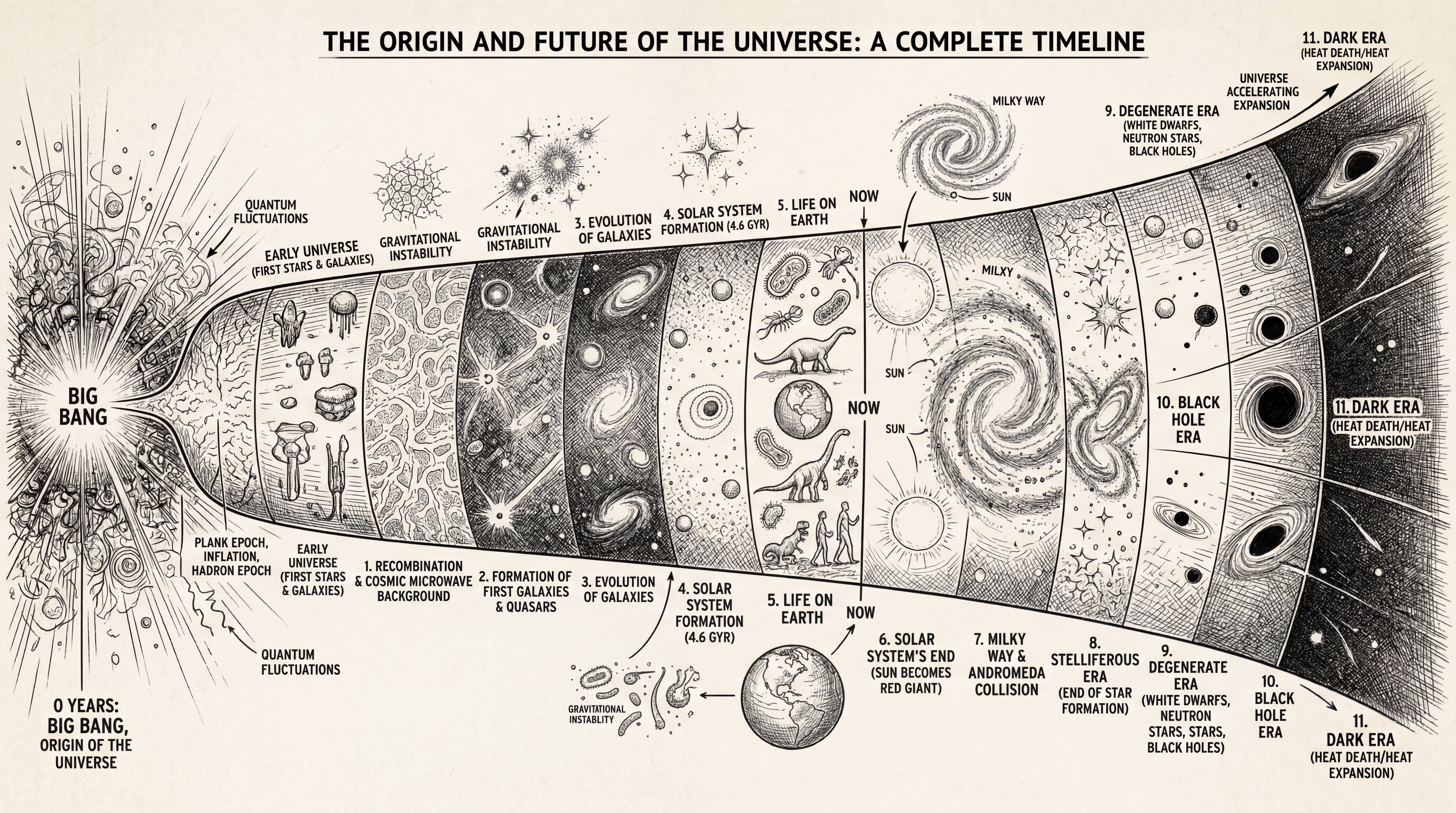
The standard cosmological model says the observable universe emerged from an early hot dense state roughly 13.8 billion years ago. "Big Bang" does not mean an explosion into pre-existing empty space; it refers to the expansion of spacetime itself from a very dense early condition. In the earliest fractions of a second, cosmic inflation may have stretched quantum fluctuations into macroscopic seeds that later became galaxies and clusters. As the universe cooled, elementary particles formed nuclei, then atoms, then stars, galaxies, heavy elements, planets, and eventually the chemical preconditions for life.
Today the universe is structured into a cosmic web of filaments, voids, halos, galaxies, and clusters. Its future depends on the long-term behavior of expansion, dark energy, star formation, black hole evaporation, and particle stability. Under the currently favored picture, star formation gradually declines, galaxies become dimmer, black holes dominate energetic processes for enormous timescales, and the universe drifts toward a cold low-activity state often described as heat death.
Inflation, reheating, particle formation, and primordial nucleosynthesis set the initial physical conditions.
Dark matter scaffolding and gravitational instability guide the growth of galaxies, clusters, and large-scale patterns.
Stars synthesize heavy elements and create the chemical basis for planets, atmospheres, and biology.
Expansion, stellar exhaustion, black hole evolution, and thermodynamic decline define the deep-time cosmic horizon.
One reason the standard cosmological model became so persuasive is that it does not only narrate cosmic history; it predicts relics. Inflation explains why the observable universe looks so nearly spatially flat and why causally disconnected regions share remarkably similar large-scale properties. Recombination, around 380,000 years after the Big Bang, marks the epoch when electrons and nuclei combined into neutral atoms, allowing photons to decouple and free-stream across the universe. Those photons are now observed as the cosmic microwave background.
The CMB is one of the cleanest windows into early-universe physics. Its temperature anisotropies encode primordial fluctuations, baryon density, total matter density, acoustic oscillation scales, and geometric information about cosmic expansion. Precision cosmology became precision cosmology because the CMB turned the early universe into a measurable dataset rather than a purely speculative narrative.
Radiation redshifts both in number density and photon energy, so it dilutes faster than matter.
Matter density falls with volume expansion, which is why matter eventually overtook radiation as the dominant component.
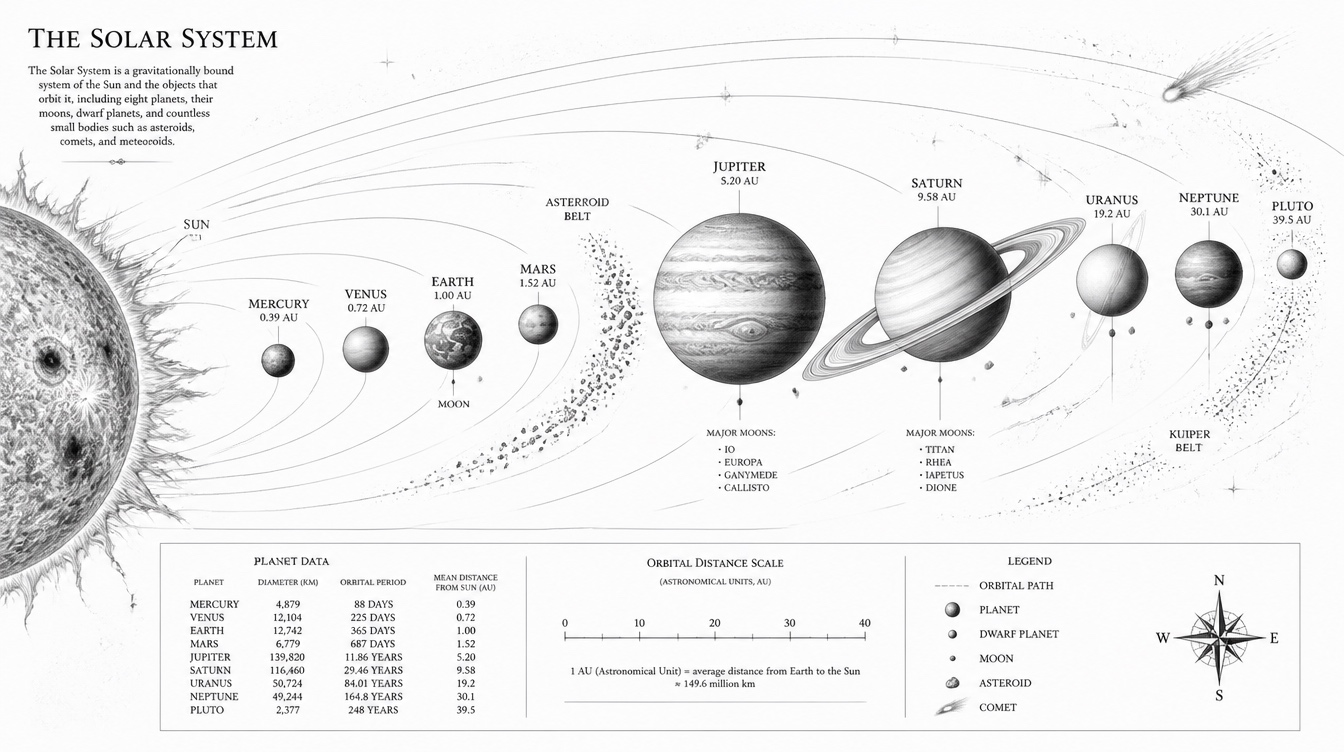
The Solar System is a local laboratory for planetary science. It preserves the record of star formation, planet formation, orbital dynamics, geochemical differentiation, and impact history. Earth is the only known biosphere, but it is also a fragile planetary system with finite climate stability and geological constraints. The Moon preserves impact history and offers a near-Earth platform for future astronomy and resource experiments. Mars remains scientifically compelling because it preserves evidence of a thicker ancient atmosphere, past water activity, and perhaps a once-more-habitable surface environment.
Mars is not simply a farther desert. It has low gravity, almost no breathable atmosphere, high radiation exposure, abrasive dust, extreme cold, long resupply delay, psychological isolation, and a weak natural magnetic shield. Every kilogram of habitat reliability, shielding, energy, life support, and maintenance becomes a compounding systems problem.
This is why Elon Musk's colonization vision still appears distant to me. The engineering challenge is both transport and stable closed-loop survival, industrial bootstrapping, medicine, governance, and economics under permanently hostile conditions.
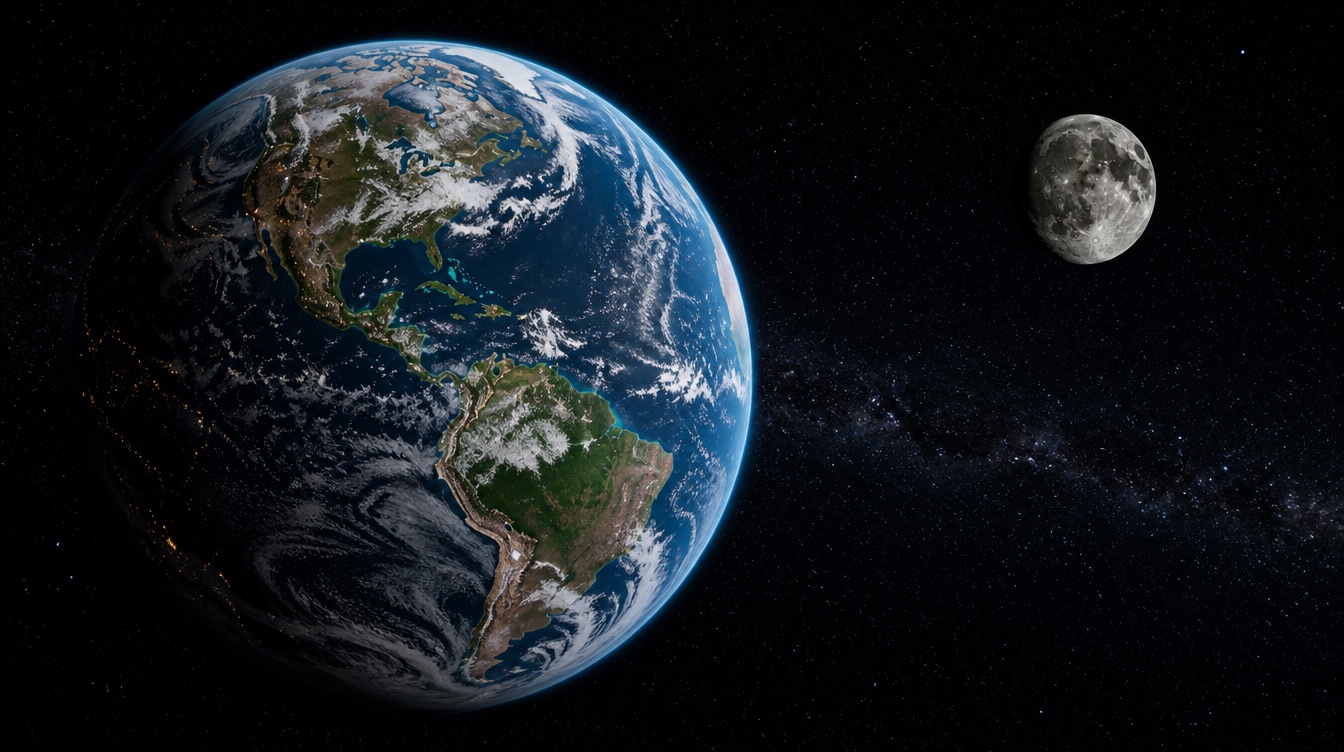
Earth is our home and the reference planet for climate balance, liquid water stability, biogeochemical feedback, and intelligent observation. The Moon preserves an accessible geological record and may support future astronomy and cislunar infrastructure.
Habitability is not a binary label. It depends on stellar radiation stability, planetary mass, atmosphere retention, magnetic shielding, internal heat flow, volatile inventory, long-term climate feedback, and chemical cycling. Earth is special not because it is merely rocky and in a habitable zone, but because it combines liquid-water stability, active geology, magnetic shielding, biospheric feedback, and an exceptionally favorable long-duration environmental balance.
Mars is scientifically alluring precisely because it seems to have lost some of those stabilizing conditions. Its surface preserves ancient fluvial signatures, sedimentary records, and mineralogical evidence that point to a wetter earlier epoch. But reconstructing past habitability is not the same as engineering present habitability. Human settlement would demand industrial ecology, not just rocket transport.
Any serious Mars architecture remains constrained by propulsion physics, staging, mass ratios, and the brutal cost of carrying life-support redundancy.
Gravity shapes atmosphere retention, human physiology, dust behavior, launch economics, and long-term biomechanical adaptation.
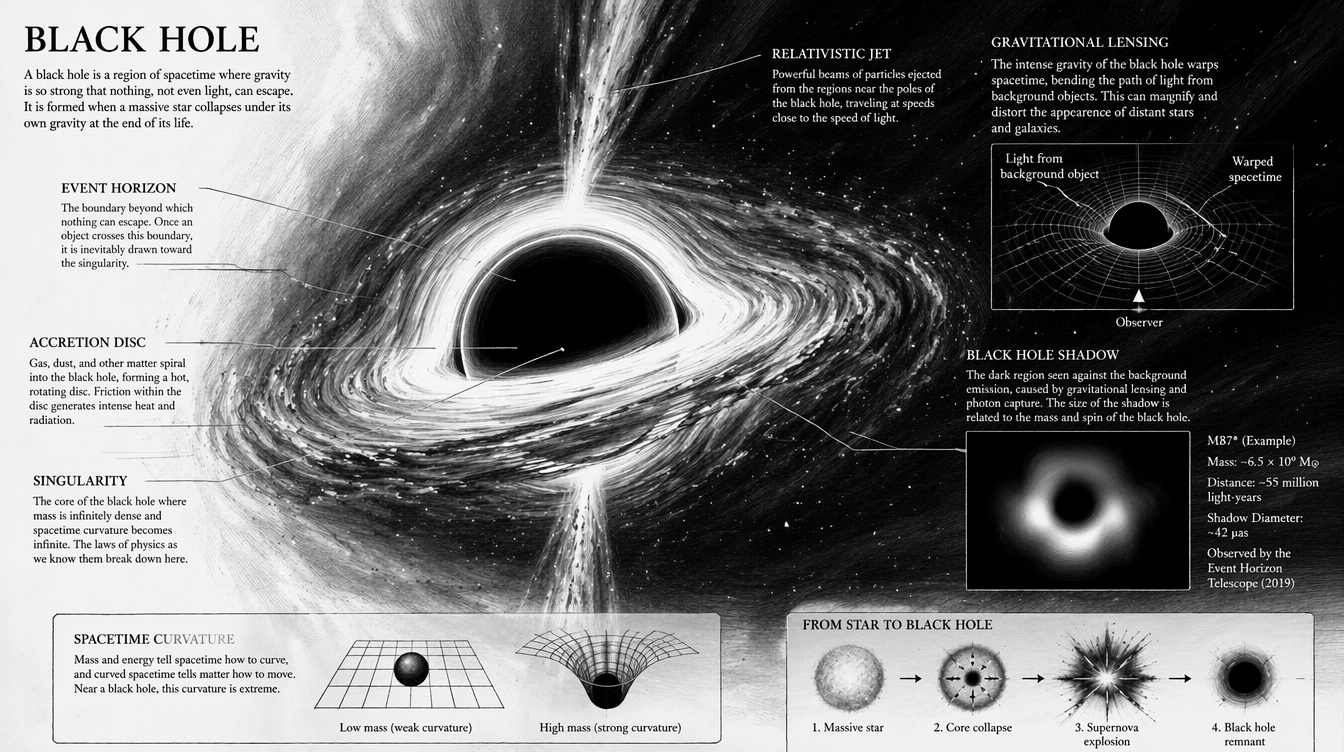
Black holes are regions where gravity is so intense that, within the event horizon, escape to the external universe becomes impossible. They are predicted by general relativity, but modern black-hole science now combines relativity, accretion physics, plasma astrophysics, high-energy astronomy, and information theory. There are stellar-mass black holes formed by massive star collapse, supermassive black holes at galactic centers, and possible intermediate-mass black holes whose population is still under investigation. Primordial black holes remain hypothetical and, if they exist, could affect cosmology and dark matter debates.
| Type | Typical scale | Formation route | Research interest |
|---|---|---|---|
| Stellar-mass black holes | Several to tens of solar masses | Core collapse of massive stars or compact-object mergers | X-ray binaries, merger physics, relativistic jets |
| Intermediate-mass black holes | Hundreds to thousands of solar masses | Uncertain; may involve cluster dynamics or repeated mergers | Bridge population between stellar and supermassive classes |
| Supermassive black holes | Millions to billions of solar masses | Early seeding plus long accretion and merger history | Galaxy evolution, AGN, feedback, quasar activity |
| Primordial black holes | Hypothetical broad mass range | Early-universe density fluctuations | Dark matter speculation, early-cosmos constraints |
Black holes matter because they test gravity in extreme regimes, shape galaxies through feedback, power some of the brightest known astrophysical phenomena, and force unresolved questions about information, entropy, quantum gravity, and spacetime itself.
Black holes are not only conceptually dramatic; they are quantitatively precise objects within classical general relativity. Their characteristic scales, temperatures, and luminosity constraints make them central to both theory and observation.
This defines the horizon radius for a non-rotating uncharged black hole and gives the most basic mass-to-size relation in black-hole physics.
Quantum field theory on curved spacetime predicts that black holes radiate thermally; larger black holes are colder.
This gives an approximate upper luminosity where radiation pressure balances gravitational infall for ionized gas accretion.
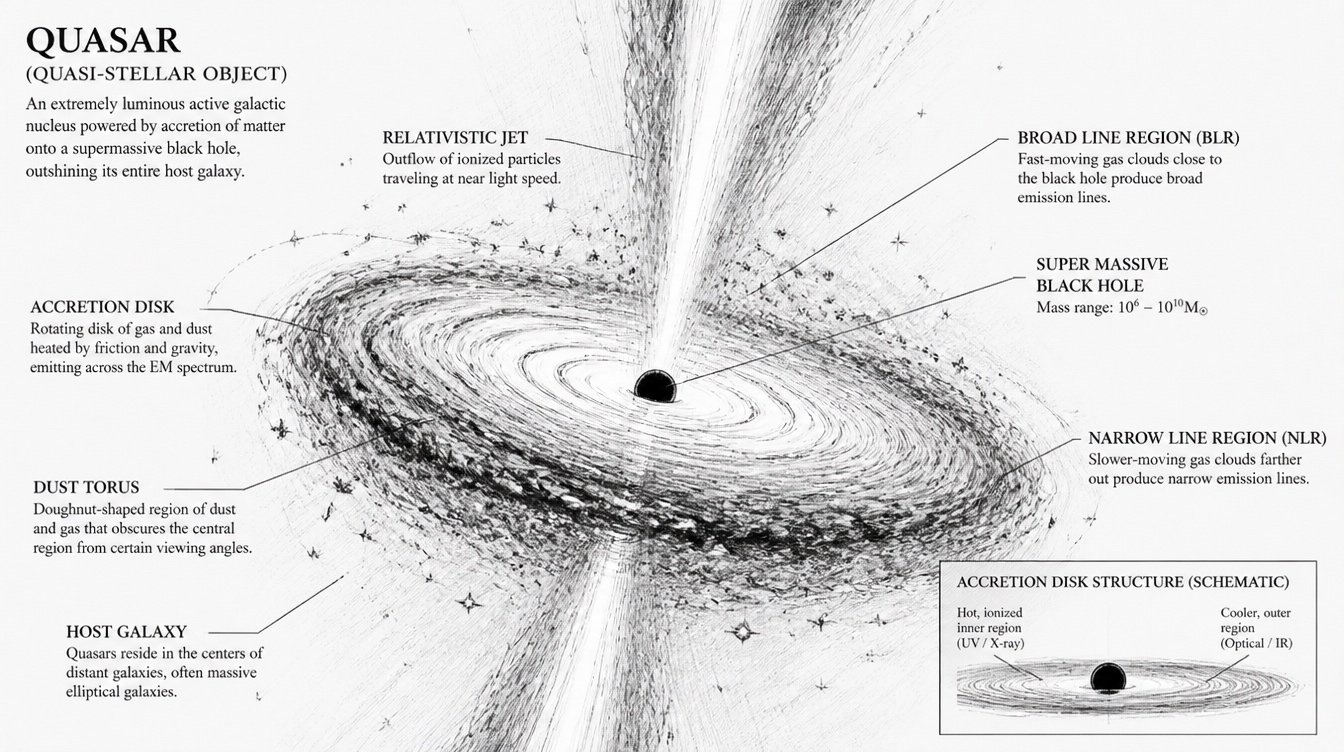
Quasars are among the most luminous persistent objects in the universe. They are not stars, even though their early optical appearance suggested starlike sources. They are powered by matter accreting onto supermassive black holes in galactic nuclei. As gas spirals inward through an accretion disk, gravitational energy is converted into heat and radiation with extraordinary efficiency.
Quasar research reveals the growth history of black holes, the state of the early universe, the chemical enrichment of galaxies, and the relation between black-hole feeding and galaxy-scale feedback. Some quasars are seen at extremely high redshift, which means they probe a remarkably early cosmic epoch and raise difficult questions about how supermassive black holes grew so quickly after the cosmic beginning.
A universe article becomes more professional when it emphasizes that most large-scale cosmic claims are observational inferences extracted from light. Distances are not directly attached to galaxies; they are estimated through a ladder of methods including parallax, Cepheids, Type Ia supernovae, baryon acoustic oscillations, and model-dependent cosmological fits. In cosmology, redshift records expansion history rather than merely describing a color shift.
At relatively low redshift, recessional velocity scales approximately with distance, revealing universal expansion.
Observed flux \(F\) and intrinsic luminosity \(L\) define luminosity distance, a central quantity in supernova cosmology.
The Fermi paradox is not a proof that extraterrestrial civilizations do not exist. It is a tension between two claims that individually seem plausible: first, the universe is vast, old, chemically rich, and full of stars with planets; second, we do not see clear evidence of galaxy-spanning technological civilizations. The paradox is often summarized by Enrico Fermi's question, "Where is everybody?" but its modern force comes from astrophysics, planetary science, evolutionary biology, technological forecasting, and observational silence taken together.
If star formation has been underway for billions of years, if many stars are older than the Sun, and if at least some fraction of habitable worlds produce life and intelligence, then one might expect long-term technological signatures to be observable: probes, engineering artifacts, waste heat, industrial spectra, radio leakage, artificial transits, stellar-scale restructuring, or unmistakable astroengineering footprints. Yet none of these has been confirmed at civilization scale. The paradox therefore lives in the gap between probabilistic expectation and observational absence.
The Drake equation decomposes the problem into star formation, planet frequency, habitability, biogenesis, intelligence, communication, and civilization lifetime.
Perhaps simple life is common but complex multicellular life, intelligence, language, and durable technological civilization are each improbably difficult transitions.
One or more stages between chemistry and cosmic-scale civilization may be extremely hard. The unresolved question is whether the filter lies behind us or ahead of us.
Advanced civilizations may deliberately avoid contact, treat emerging worlds as protected systems, or communicate in forms we do not recognize.
We may be searching for the wrong signatures. Civilizations might use non-radio channels, low-leakage networks, or short-lived communication windows.
Economic, ecological, ethical, or post-biological transitions may reduce the incentive for large visible expansion across the galaxy.
Humanity has only recently developed serious exoplanet science, SETI signal processing, technosignature theory, and high-precision all-sky instrumentation.
A rigorous treatment of the paradox must also separate biosignatures from technosignatures. Finding atmospheric oxygen, methane disequilibrium, or surface chemistry compatible with life would not resolve the paradox, because microbial or pre-technological life can exist without creating detectable engineering. Likewise, failure to detect radio transmissions does not imply emptiness; it may only imply that our search space in time, spectrum, sensitivity, and target selection remains extremely incomplete.
For that reason, the Fermi paradox remains powerful but underdetermined. It disciplines speculation by forcing every optimism about abundant intelligence to answer a hard empirical question: if advanced civilizations are common, what observable residue should their existence leave behind, and why have we not found it yet?
The universe is not populated by a single kind of object repeated at scale. It is a layered zoo of bodies, remnants, media, structures, and transient events, each produced by different physical regimes. The cards below provide a quick taxonomy; each one opens a more detailed academic-style explanation.
Hydrogen-burning stars like the Sun, where radiation pressure and gravity remain in long-lived balance.
Evolved stars with expanded envelopes, strong mass loss, and late-stage nuclear burning structure.
Electron-degeneracy-supported stellar remnants left behind by low- and intermediate-mass stars.
Extreme compact remnants where nuclear-density matter, rapid rotation, and intense magnetic fields dominate.
Diffuse gas and dust environments that can be remnants of stellar death or nurseries of future stars.
Large gravitational systems of stars, gas, dust, dark matter, and black holes, arranged in a cosmic hierarchy.
Planets around other stars, ranging from hot Jupiters and super-Earths to potentially temperate rocky worlds.
Leftover building blocks of planetary formation that preserve early Solar System chemistry and impact history.
They transformed the cosmos from a closed Earth-centered order into a mathematically structured dynamical system governed by universal laws.
General relativity changed gravity from force to geometry and made modern cosmology possible.
They established the expanding universe and made large-scale cosmic evolution scientifically concrete.
They shaped Big Bang nucleosynthesis and the interpretation or discovery of the cosmic microwave background.
They reshaped compact-object physics, singularity theory, and black-hole thermodynamics.
Galaxy rotation evidence helped cement the dark matter problem as a central fact of cosmology.
Modern universe research depends as much on infrastructure as on theory. Ground-based observatories, radio interferometers, gravitational-wave detectors, cryogenic satellites, exoplanet missions, high-performance computing clusters, sky-survey archives, and calibration pipelines all act as epistemic machinery. The James Webb Space Telescope, Euclid, Vera Rubin Observatory, ALMA, the Event Horizon Telescope, LIGO-Virgo-KAGRA, and future projects such as LISA and the Extremely Large Telescope together define the practical horizon of current cosmology and high-energy astrophysics.
This matters because scientific progress in cosmology increasingly comes from integration: image data, spectra, time-domain variation, gravitational-wave triggers, simulation catalogs, and Bayesian inference systems must all align. The future is not only better seeing; it is better system architecture for scientific evidence.
The universe is scientifically powerful precisely because it still refuses full explanation. Dark matter has strong gravitational evidence but no confirmed particle identity. Dark energy drives acceleration, yet its physical nature remains unclear. We do not know what preceded inflation, whether inflation occurred exactly as often modeled, whether spacetime is emergent, how gravity unifies with quantum theory, whether life is common, how consciousness fits into a cosmic evolutionary narrative, or whether the observed constants of nature are unique or contingent.
Real mass effect, unknown microscopic identity.
Observed acceleration, unclear physical mechanism.
No completed theory unifies general relativity and quantum mechanics at all scales.
How information survives or is encoded in evaporating black-hole systems remains contested.
We still do not know whether intelligent life is rare, common, or short-lived.
Different methods of measuring cosmic expansion rate still disagree at a statistically serious level.
Universe research is becoming more data-intensive, more multi-messenger, more computational, and more interdisciplinary. Observational astronomy no longer depends on visible light alone. Gravitational waves, neutrinos, radio arrays, X-ray satellites, exoplanet spectroscopy, large sky surveys, and numerical simulation now form a joint ecosystem. The future belongs both to bigger telescopes and to better integration of observation, simulation, statistics, AI-assisted signal extraction, and cross-domain scientific modeling.
Important trends include precision cosmology, gravitational-wave astronomy, exoplanet atmosphere characterization, black-hole imaging, early-universe inference, high-fidelity numerical simulation, asteroid and planetary resource analysis, lunar infrastructure, and AI-supported scientific discovery pipelines. In all of these, one sees the same pattern: the universe is increasingly studied not as isolated observations, but as an interconnected inferential system.
宇宙并不只是诗意意义上的“万物总和”。在物理学与宇宙学中,宇宙是时空、物质、辐射、量子场、大尺度结构以及支配它们相互作用的动力学规律所构成的整体演化系统。要严肃地谈宇宙,就必须同时处理多个尺度:亚原子粒子、恒星、星系、星系团、暗物质晕、黑洞、星际化学、行星表面,以及在观测视界之外、目前光还来不及到达的区域。
因此,现代宇宙图景是宇宙学、天体物理学、行星科学、相对论、量子理论、等离子体物理、光谱学、地球物理、观测仪器与计算科学共同交织的结果,并非某一门学科的孤立成果。它既宏大,也极其技术化;既追问起源,也追问结构、常数、生命与终局。
专业宇宙学还有一个非常重要的特点:它始终受到观测位置和观测手段的限制。我们只能从宇宙中的一个极小位置、在一个非常短的历史阶段里,通过有限光速、有限探测器精度、有限口径、有限校准能力去推断整体。因此宇宙学是依赖红移巡天、光谱、微波背景各向异性、引力透镜、引力波与统计模型去重建宇宙,并非“直接拥有宇宙全貌”。
宇宙不仅包含其中的星体,也包含时空本身。它包括恒星、行星、气体、尘埃与生命化学所构成的重子物质;通过引力间接显现的暗物质;宇宙微波背景辐射等辐射成分;以及与宇宙加速膨胀相关的暗能量样成分。
由相对论描述的几何舞台,在这里距离、时间、曲率与引力不可分割。
普通物质构成原子、分子、恒星、行星与观察者,但它只占宇宙总能量预算的一小部分。
通过星系旋转与大尺度结构形成等引力效应被间接确认,但粒子身份仍未确定。
用来命名晚期宇宙加速膨胀现象的概念,是基础物理中最深的未解问题之一。
专业宇宙学并不只是叙述性知识,它首先是一个由方程组织起来的理论结构。现代宇宙图景的说服力,来自相对论几何、流体近似、热力学、辐射输运与统计推断共同构成的数学骨架。下面这些公式并不构成全部宇宙学,但它们是最典型的结构锚点之一。
这个度规描述各向同性、均匀宇宙,其中尺度因子 \(a(t)\) 编码膨胀历史,\(k\) 表示空间曲率。
宇宙膨胀率由总能量密度、空间曲率和宇宙学常数共同决定,是标准宇宙学最核心的方程之一。
宇宙学红移刻画的是发光时刻与观测时刻之间,宇宙尺度增长了多少。
临界密度提供了表达 \(\Omega_m\)、\(\Omega_\Lambda\) 等宇宙组分比例的自然基准。
标准宇宙学模型认为,可观测宇宙约在 138 亿年前从一个早期极热极密状态演化而来。“大爆炸”是时空本身的膨胀,并非物质向预先存在的空无空间里炸开。宇宙在最初极短时间里可能经历暴涨,使量子涨落被拉伸成宏观尺度,后来成为星系与星系团的种子。随着冷却,基本粒子、原子核、原子、恒星、星系、重元素、行星以及生命所需化学条件才逐渐出现。
今天的宇宙在大尺度上呈现出由丝状结构、空洞、暗物质晕、星系和星系团构成的宇宙网。它的未来取决于膨胀、暗能量、恒星形成、黑洞蒸发与粒子稳定性等长期行为。按目前最主流的图景,恒星形成会逐渐衰减,星系逐步变暗,黑洞在极长时间尺度上主导高能过程,而宇宙整体则趋向一个低温、低活动度的“热寂”状态。
暴涨、再加热、粒子形成与原初核合成,奠定了后续演化的初始条件。
暗物质支架与引力不稳定性共同引导星系、星系团和宇宙网的生成。
恒星合成重元素,为行星、行星大气与生命化学创造物质基础。
膨胀、恒星耗尽、黑洞演化与热力学衰减构成宇宙远未来的基本图景。
标准宇宙学之所以强大,并不只是因为它提供了一条宇宙叙事链,更因为它预测了可以被观测到的“遗迹”。暴涨理论解释了为什么可观测宇宙在大尺度上如此接近平坦,以及为什么原本似乎因果上彼此隔绝的区域会呈现出高度一致的统计性质。复合时期大约发生在大爆炸后 38 万年左右,此时电子与原子核结合成中性原子,光子得以退耦并在宇宙中自由传播,这批光子今天就构成宇宙微波背景。
宇宙微波背景是早期宇宙物理最干净的观测窗口之一。它的温度各向异性携带着原初涨落、重子密度、总物质密度、声学振荡尺度以及宇宙几何的信息。精密宇宙学之所以成为精密宇宙学,关键就在于早期宇宙终于被转化为高质量数据,而不再只是高度抽象的形而上想象。
辐射不仅数密度随体积膨胀下降,单个光子的能量也会红移,因此它稀释得比物质更快。
物质密度主要随体积膨胀而变化,这也是为什么宇宙会从辐射主导逐步过渡到物质主导。
太阳系是行星科学最重要的本地实验室,它保留着恒星形成、行星形成、轨道动力学、地球化学分异与撞击历史的证据。地球是目前唯一已知的生命行星,但它同时也是一个脆弱的行星系统,受到气候、地质和资源边界的约束。月球保存了大量早期撞击记录,也是未来近地空间基础设施和天文观测的潜在平台。火星之所以格外重要,是因为它保留了较厚古大气、曾经水活动以及可能更宜居表面环境的痕迹。
火星不是一个更远的沙漠而已。它具备低重力、几乎不可呼吸的大气、高辐射、极寒、强磨损尘埃、长期补给延迟以及极端隔离等多重问题。每一公斤栖居可靠性、辐射屏蔽、能源、生命支持与维修能力,都会叠加成系统级难题。
这也是为什么在我看来,马斯克的火星计划依旧遥遥无期。真正困难的不只是运过去,而是如何在一个长期敌对环境里建立闭环生存、工业自举、医疗、治理以及可持续经济。
地球是我们的家园,也是理解气候平衡、液态水稳定性、生物地球化学反馈与智能观察者位置的基准行星。月球保存着便于研究的地质记录,未来还可能支持天文观测与地月空间基础设施。
宜居性从来不是一个简单的是非标签。它取决于恒星辐射稳定性、行星质量、大气保持能力、磁场屏蔽、内部热演化、挥发分储量、长期气候反馈以及化学循环。地球之所以特殊,并不只是因为它是一颗位于宜居带的岩石行星,而是因为它同时拥有液态水稳定、活跃地质过程、磁场保护、生物圈反馈和极其难得的长期环境平衡。
火星之所以迷人,正是因为它似乎失去了其中一部分关键条件。它表面保存了古河道、沉积记录与矿物学证据,显示早期火星可能更湿润、更温暖,也可能更接近宜居。但重建过去的宜居性,不等于能够工程化地制造当前宜居性。真正的火星定居问题,最终是工业生态和系统工程问题,而不只是运载火箭问题。
任何严肃的火星架构最终都受推进物理、级间设计、质量比以及生命支持冗余成本的硬约束。
重力会影响大气保持、人体生理、尘埃运动、起飞经济性以及长期生物力学适应。
黑洞是引力强到在事件视界以内无法逃逸到外部宇宙的区域。它由广义相对论预言,但现代黑洞研究早已不只是相对论问题,而是结合了吸积物理、高能天体物理、等离子体过程、喷流、引力波与信息理论的交叉领域。我们目前讨论的黑洞包括由大质量恒星塌缩形成的恒星级黑洞、位于星系中心的超大质量黑洞、仍在寻找人口统计证据的中等质量黑洞,以及假想中的原初黑洞。
| 类型 | 典型尺度 | 形成路径 | 研究重点 |
|---|---|---|---|
| 恒星级黑洞 | 数个到数十个太阳质量 | 大质量恒星核心塌缩或致密天体并合 | X 射线双星、并合物理、相对论喷流 |
| 中等质量黑洞 | 数百到数千太阳质量 | 可能涉及星团动力学或重复并合,仍未完全明确 | 连接恒星级与超大质量黑洞的人口桥梁 |
| 超大质量黑洞 | 数百万到数十亿太阳质量 | 早期种子加长期吸积与并合增长 | 星系演化、AGN、反馈、类星体活动 |
| 原初黑洞 | 假想中的广泛质量区间 | 早期宇宙密度涨落 | 暗物质假说与早期宇宙约束 |
黑洞之所以重要,是因为它们让我们在极端引力条件下检验物理规律,同时也深刻影响星系演化,并把信息、熵、量子引力和时空本质这些最困难的问题压缩到一个共同焦点里。
黑洞不仅概念上极端,它们在经典广义相对论里也是定量上非常精确的对象。其特征尺度、温度与吸积亮度上限,使黑洞同时成为理论物理和观测天体物理的核心对象。
它给出无电荷、无自转黑洞的视界尺度,是黑洞“质量-尺寸关系”的最基本表达。
曲率背景上的量子场论预言黑洞会表现出热辐射特征,而且质量越大的黑洞温度越低。
它近似描述电离气体吸积时,辐射压与引力平衡所允许的亮度上限。
类星体是宇宙中最明亮的持续性天体之一。它们并不是恒星,尽管最早光学上看起来像“星点”。它们的能量来自物质落向超大质量黑洞时形成的吸积盘。气体在盘中向内螺旋,巨大的引力势能被转换为热和辐射,因此产生极高光度。
类星体研究之所以重要,是因为它帮助我们理解黑洞生长史、早期宇宙状态、星系化学演化,以及黑洞“进食”与星系尺度反馈之间的关系。某些高红移类星体出现在极早宇宙时期,这也反过来提出一个困难问题:超大质量黑洞究竟如何在宇宙诞生后如此短的时间内快速长大。
一篇宇宙文章如果要更专业,就必须明确指出:大尺度宇宙学结论几乎都来自光学与多波段信号的反演。距离并不是天然附着在星系上的属性,它必须通过视差、造父变星、Ia 型超新星、重子声学振荡以及带有模型依赖性的宇宙学拟合来估计。红移也不只是颜色偏移,而是膨胀史在观测上的坐标痕迹。
在相对低红移范围内,退行速度与距离近似成正比,这是宇宙整体膨胀最直观的经验规律。
观测流量 \(F\) 与本征光度 \(L\) 共同定义光度距离 \(d_L\),这是超新星宇宙学的关键量之一。
费米悖论是一种张力:一方面,宇宙极其巨大、极其古老、化学元素丰富,恒星和行星数量惊人,并非“外星文明不存在”的证明;另一方面,我们至今没有看到明确、可确认、可重复验证的银河系尺度技术文明证据。它常被概括成费米那句著名的问题:“Where is everybody?” 但真正使它具有现代科学力量的,是天体物理、行星科学、演化生物学、技术寿命推断以及观测沉默一起构成的背景。
如果恒星形成已持续数十亿年,如果许多恒星比太阳更老,如果适居行星并不罕见,那么只要生命、智能和技术文明在其中某个概率上并不极端稀有,人们就会自然期待看到某些长时段技术痕迹:探测器、工程遗迹、废热、工业光谱、人工凌日、恒星尺度工程,或者其他不可误认的天文技术签名。但到目前为止,我们并没有确认这样的证据。费米悖论真正存在于“统计上似乎应该有”与“经验上还没看到”之间。
德雷克方程是一种问题分解框架:把恒星形成率、行星比例、宜居世界数量、生命起源概率、智能演化概率、通信技术概率与文明持续时间拆开讨论,并非算命公式。
也许简单生命并不罕见,但复杂生命、多细胞演化、智能、语言与长期技术文明,每一步都极其困难。
从化学到银河文明之间,可能存在一到多个极难通过的阶段。最令人不安的问题是:过滤器究竟已经在我们身后,还是还在前方。
高级文明可能有意识地避免接触,把新兴文明当作受保护系统,或者使用我们目前无法识别的交流形式。
我们可能根本找错了东西。文明未必长期泄漏无线电,也可能采用低泄漏通信、局域网络、短寿命窗口或非电磁信号。
技术文明未必会选择可见的大规模扩张。经济、伦理、生态约束,甚至后生物形态转变,都可能降低外向殖民动机。
人类真正具备严肃的系外行星科学、SETI 信号处理、技术签名理论和大规模高精度巡天能力,其实只是很近几十年的事情。
更严谨地说,费米悖论还要求我们区分 biosignature 和 technosignature。即便未来发现富氧大气、甲烷失衡或与生命相容的化学状态,也不等于解决了悖论,因为微生物生命和前技术文明完全可能长期存在,却不产生可见工程痕迹。反过来,没有搜到无线电,也不能说明宇宙空无一人,只能说明我们搜索的时间、频段、灵敏度和目标集仍然非常有限。
正因为如此,费米悖论今天仍然是一个极强但并未定解的问题。它迫使所有关于“宇宙中智能很多”的乐观推断,都必须回应一个严格经验问题:如果高级文明真的常见,它们理应留下什么观测残留?而我们为什么还没有确认看到?
宇宙并不是由一种“天体”无限复制组成的。它是一个分层的对象系统:恒星、残骸、星际介质、行星、小天体、星系、星系团以及各种瞬态事件,分别由不同的物理机制塑造。下面的卡片先给出简短分类,每一张都可以点开查看更详细的学术式说明。
像太阳这样的氢燃烧恒星,在相当长时间里维持辐射压与引力平衡。
进入晚期演化的膨胀恒星,包层巨大,质量损失显著,内部核燃烧结构更复杂。
由电子简并压支撑的恒星残骸,是中低质量恒星演化末期的典型产物。
核密度物质、极快自转与强磁场共同支配的极端致密天体。
弥散气体和尘埃环境,既可能是恒星死亡遗迹,也可能是新恒星的诞生地。
由恒星、气体、尘埃、暗物质和黑洞共同构成的大尺度引力系统。
围绕其他恒星运行的行星,从热木星、超级地球到潜在温带岩石行星都有。
行星形成遗留下来的“小块资料库”,保存着早期太阳系的化学与撞击历史。
他们把宇宙从封闭的地心秩序,改写成一个可数学描述、由普遍规律支配的动力系统。
广义相对论把引力从“力”改写为时空几何,是现代宇宙学的基础之一。
他们确立了膨胀宇宙的观念,让宇宙演化变成可以被科学追踪的事实。
他们共同塑造了大爆炸核合成与宇宙微波背景相关的早期宇宙图景。
他们重塑了致密天体、奇点理论与黑洞热力学的基本问题。
她关于星系旋转的证据帮助暗物质问题从猜想变成宇宙学核心事实。
现代宇宙研究和其说依赖“单个伟大理论家”,不如说越来越依赖基础设施体系。地基望远镜、射电干涉阵列、引力波探测器、低温卫星、系外行星任务、高性能计算集群、巡天数据库以及校准流程,共同构成今天宇宙学与高能天体物理的知识机器。James Webb、Euclid、Vera Rubin Observatory、ALMA、Event Horizon Telescope、LIGO-Virgo-KAGRA,以及未来的 LISA 和 Extremely Large Telescope,基本定义了当前宇宙研究的实践边界。
这也意味着,宇宙研究的进步越来越来自整合:图像、光谱、时域变化、引力波触发、模拟目录与贝叶斯推断系统必须协同工作。未来不只是“看得更远”,而是构建更强的科学证据系统架构。
宇宙之所以科学上如此迷人,恰恰因为它仍然拒绝被完全解释。暗物质有强引力证据,却没有被确认的粒子身份;暗能量推动宇宙加速膨胀,但其物理性质仍不清楚;我们不知道暴涨之前是什么,也不知道暴涨是否真的按教科书那样发生;我们不知道时空是否是更深层结构的涌现;不知道生命在宇宙中究竟普遍还是罕见;也不知道自然常数是唯一可能,还是来自更大理论框架下的选择。
质量效应明确存在,但微观身份仍未知。
加速膨胀被观测到,但物理机制依然不清。
我们还没有完成一套在所有尺度上统一广义相对论与量子力学的理论。
信息如何在黑洞蒸发过程中保留或被编码,仍是争论焦点。
我们还不知道智能生命究竟稀有、常见,还是普遍短暂。
不同方法测得的宇宙膨胀率仍存在严肃且未完全消解的差异。
宇宙研究正在变得更数据密集、更“多信使”、更依赖计算,也更跨学科。现代天文学不再只靠可见光。引力波、微中子、射电阵列、X 射线卫星、系外行星大气光谱、大型巡天计划与高精度数值模拟,正在共同构成一个新的研究生态。未来不仅属于更大的望远镜,也属于更强的观测-模拟-统计-校准-推断一体化能力。
重要趋势包括精密宇宙学、引力波天文学、系外行星大气表征、黑洞成像、早期宇宙反演、高保真数值模拟、小行星与行星资源研究、月球基础设施建设,以及 AI 辅助的科学信号提取与研究流程。真正前沿的变化,是宇宙越来越是通过一个复杂推断系统被重建出来的,并非被“看到”的。