Zhouyi, Fuxi, Bagua, and MBTI 周易、伏羲、八卦与 MBTI
Hexagrams / symbolic reading
卦象 / 象义解读
Bagua / Bazi / MBTI / Astrology
Myth / divination / personality
神话 / 占筮 / 人格比较
Fuxi is a culture hero in early Chinese tradition. He belongs to mythic time rather than documentable biography: a civilizing ancestor associated with nets, fishing, hunting, marriage customs, writing-like signs, music, and the ordering of human society. Later tradition often places him among the Three Sovereigns and connects him with Nüwa, the human origin story, and the first arrangement of the Eight Trigrams.
Fuxi condenses a civilizational memory in which people move from chaos to pattern, from survival to ritual, and from raw nature to symbolic order. This cultural role does not depend on treating each episode as literal biography.
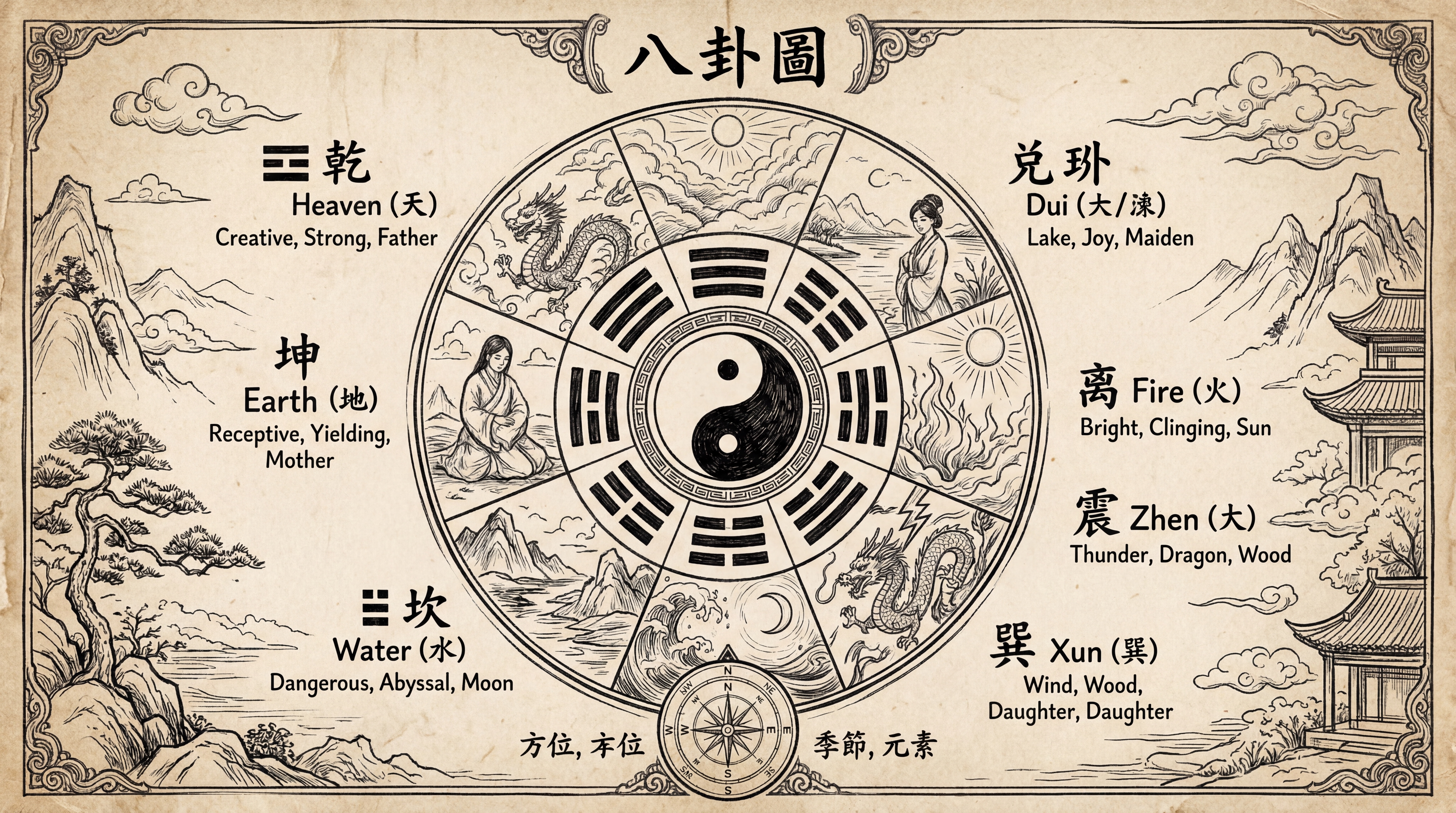
The Zhouyi is the ancient divination text built around sixty-four hexagrams. The Yijing, or Book of Changes, is the received classic that includes the Zhouyi core plus later interpretive layers traditionally associated with the Ten Wings. It became a foundational symbolic system in Chinese thought and influenced philosophy, statecraft, ritual, cosmology, literature, medicine, martial culture, and everyday language.
Its method is compact but layered: two line states form yin and yang; three lines form a trigram; two trigrams form a hexagram; six line positions add timing, rank, relation, and changing emphasis. This is why the book can be read as divination, ethics, systems language, literary image, and decision grammar at the same time.
Eight trigrams combine into sixty-four hexagrams. Each hexagram contains a name, judgment, image, and line statements.
Change is not random noise. It is patterned transformation through yin-yang relation, timing, position, response, and moderation.
This page treats the Yijing as cultural philosophy and reflective language, not as deterministic fatalism.
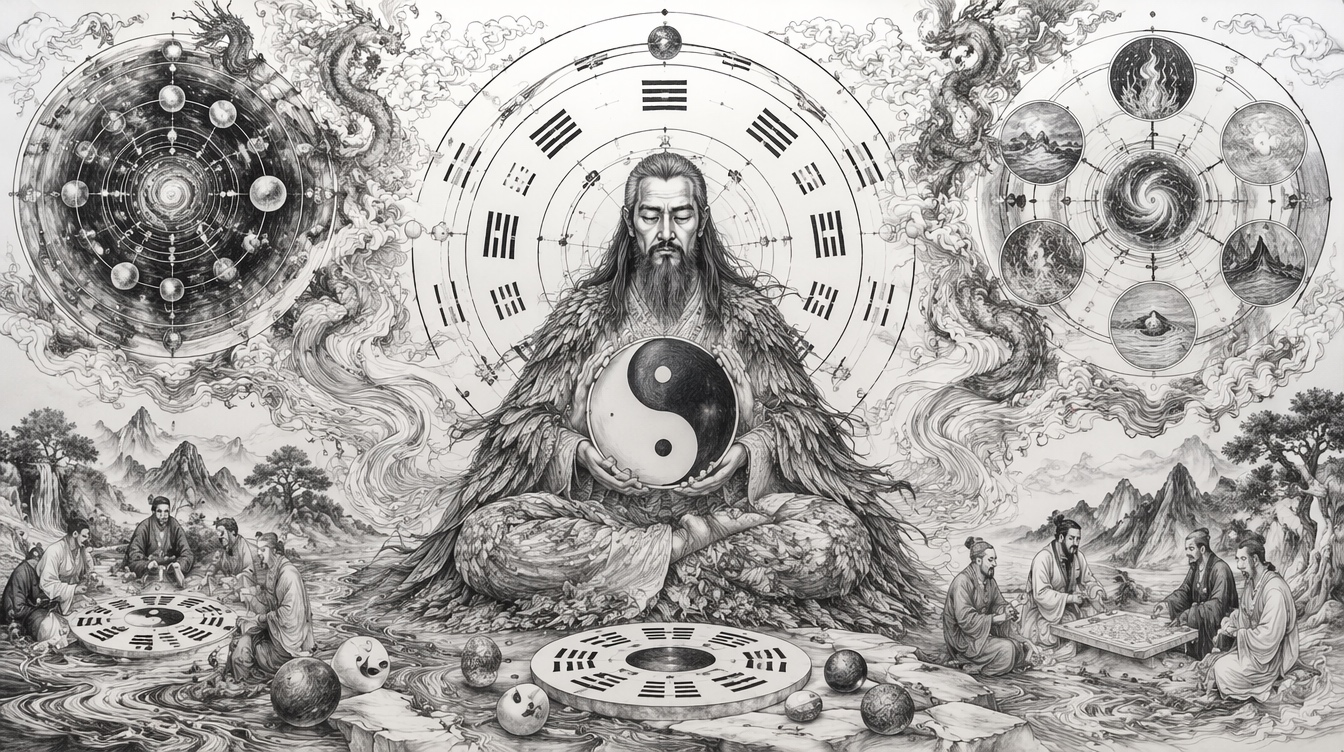
The second banner is used here as the page's visual bridge: cosmology, personal reflection, and modern personality language are treated as adjacent symbolic interfaces.
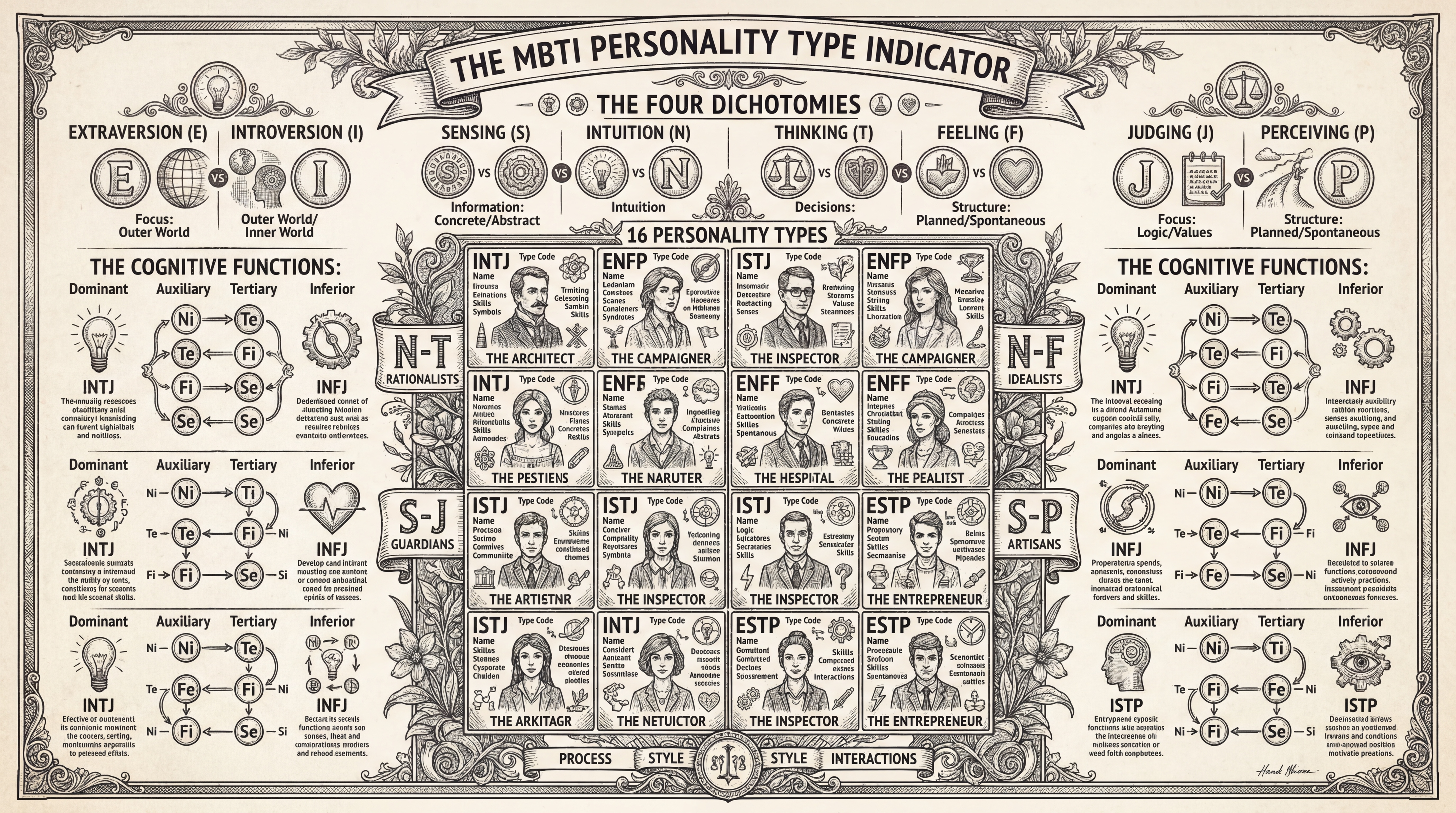
MBTI is introduced as a vocabulary for preference and dialogue, while Bagua offers a vocabulary for movement, timing, and transformation.
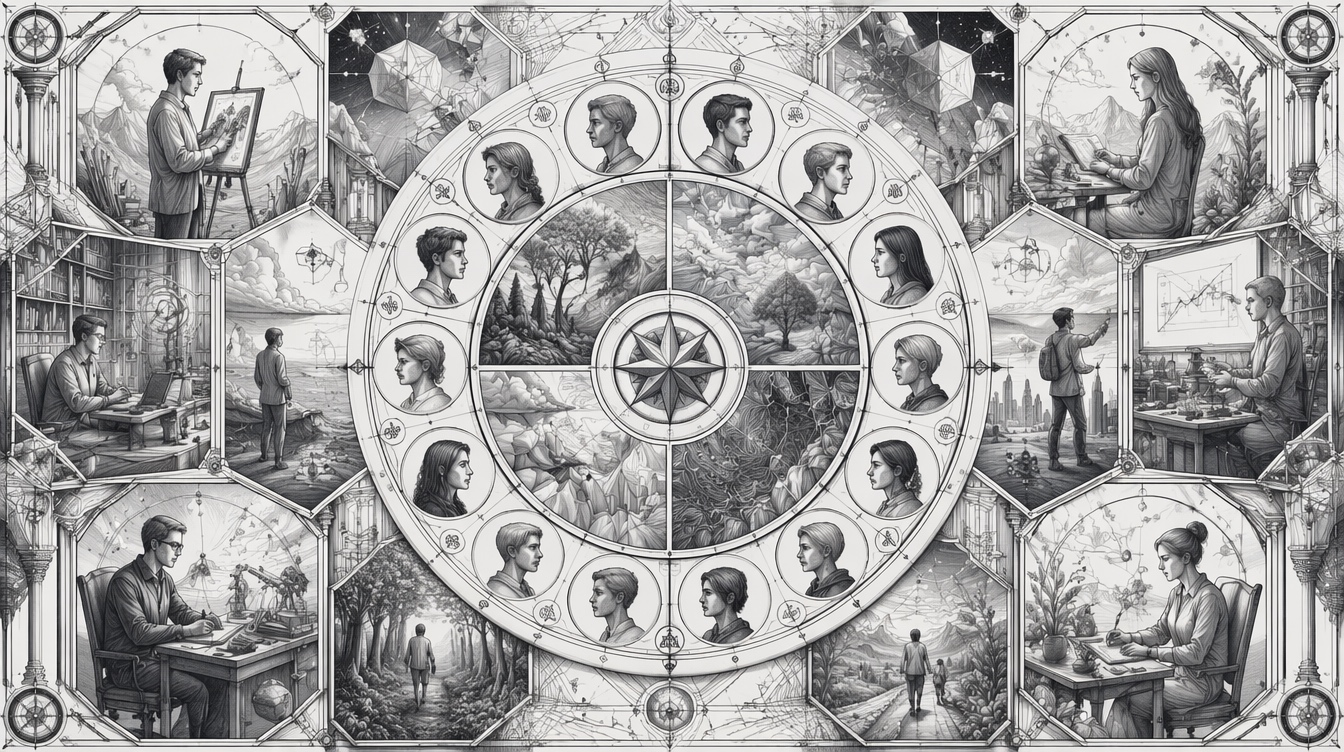
This interpretive mapping offers prompts for reflection. It should not become a rigid typology or replace professional assessment.
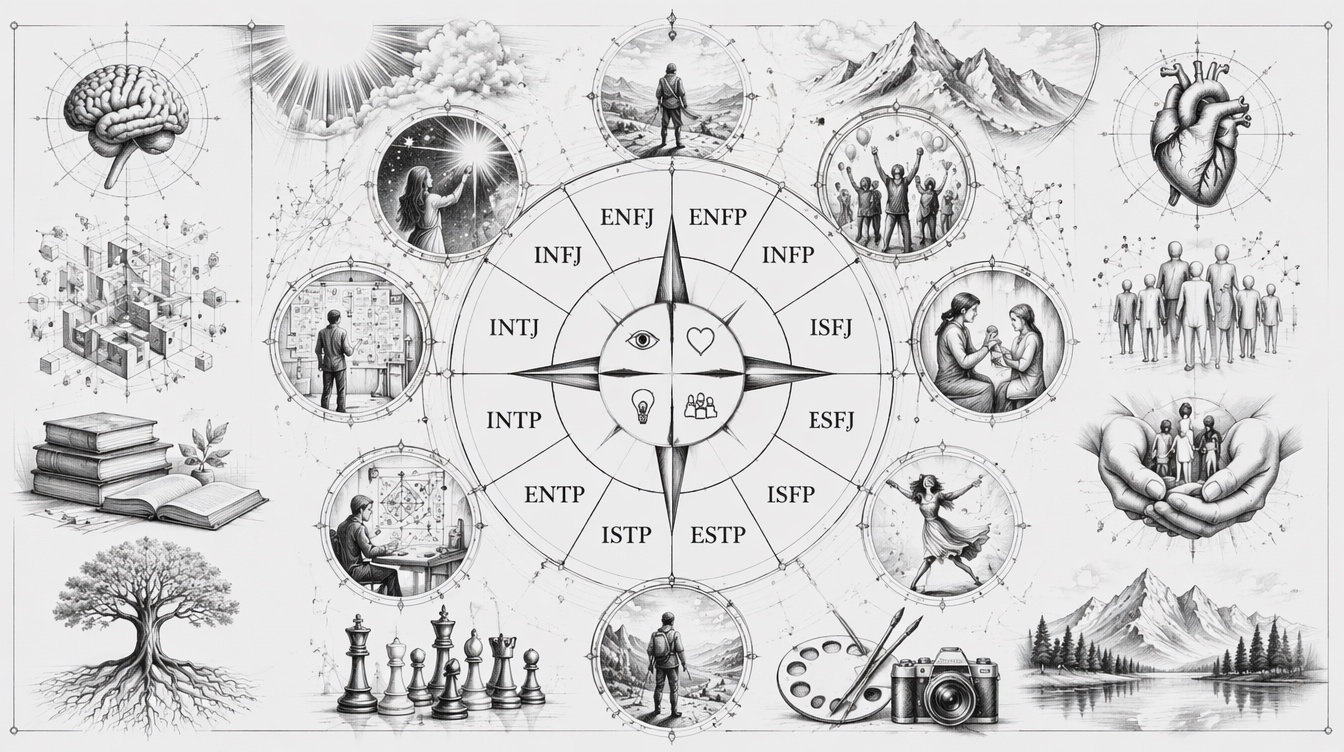
In the AI era, the Yijing offers a slower interface for scenario thinking: what is changing, what is stable, and where action should be gentle or firm. This use is reflective rather than predictive.
Creative force, initiative, leadership, pure yang, direction, structure, and the courage to begin.
Receptive support, capacity, nourishment, patience, service, trust, and the power to carry things.
Arousing movement, shock, beginning, courage after hesitation, and the first push of life.
Gentle penetration, influence, communication, refinement, adaptation, and patient persuasion.
Depth, risk, learning through difficulty, intelligence under pressure, flow, and hidden resources.
Clarity, beauty, recognition, attachment, culture, insight, and the light that makes form visible.
Stillness, boundary, meditation, completion, restraint, memory, and knowing when not to move.
Joy, speech, exchange, pleasure, openness, social resonance, and the sweetness of communication.
Modern research on the Zhouyi spans philology, excavated manuscripts, intellectual history, philosophy, anthropology, mathematics of binary symbolism, systems thinking, semiotics, and comparative religion. Serious study separates early divination practice from later Confucian, Daoist, Neo-Confucian, and popular layers, while also asking why the text remained so generative for two thousand years.
MBTI and Bagua come from very different traditions. MBTI is a twentieth-century psychological type instrument inspired by Jung and developed by Katharine Cook Briggs and Isabel Briggs Myers. Bagua is a Chinese symbolic cosmology. Any mapping between them is interpretive. As a poetic interface, the comparison places MBTI's language of cognitive preference and social energy beside Bagua's language of change.
| Trigram | Change mode | MBTI resonance | Reasoning |
|---|---|---|---|
| Qian ☰ | Creative leadership | ENTJ / ENFJ | Directive energy, high initiative, organizing force, outward leadership. |
| Kun ☷ | Receptive support | ISFJ / ESFJ | Care, continuity, responsibility, holding social and practical ground. |
| Zhen ☳ | Activation | ESTP / ENTP | Shock, improvisation, beginning through action, quick response to opportunity. |
| Xun ☴ | Gentle influence | INFJ / ENFP | Subtle persuasion, pattern sensing, soft power, communication over force. |
| Kan ☵ | Depth and risk | INTP / ISTP | Problem-solving under uncertainty, technical depth, comfort with hidden complexity. |
| Li ☲ | Clarity and expression | ENFP / ESFP | Visibility, inspiration, aesthetic presence, meaning through illumination. |
| Gen ☶ | Stillness and boundary | ISTJ / INTJ | Discipline, structure, restraint, long memory, strategic pause. |
| Dui ☱ | Joy and exchange | ESFP / ENTP | Social delight, speech, exchange, playfulness, attractive communication. |
Bagua and astrology both map human experience onto symbolic skies, seasons, directions, elements, and cycles. Astrology tends to read personality and timing through celestial positions; Bagua reads transformation through yin-yang lines, directions, family roles, images, and elemental relations. Their similarity is structural: both turn complex life into a symbolic language for reflection. Their difference is technical: Bagua is not based on planetary positions, and astrology is not based on hexagram line transformation.
Both systems use archetypes, cycles, timing, and relational interpretation. They are symbolic maps rather than laboratory measurements.
Bagua directions and five-phase associations can be compared with zodiac seasons, but no one-to-one official mapping exists.
Astrology asks, “What pattern of sky and season am I born into?” Bagua asks, “What mode of change is active now?”
AI can generate mappings quickly, but meaningful use requires humility: symbolic systems help reflection, not deterministic judgment.
Select date and time with the controls below. The calculation is a lightweight client-side cultural tool: it estimates heavenly stems and earthly branches, then generates a positive Zhouyi/Bagua reflection and MBTI learning doorway. It is for reflection and fun, not fate judgment. Saved selections stay in this browser through localStorage.
The Myers-Briggs Type Indicator was developed by Katharine Cook Briggs and Isabel Briggs Myers in the twentieth century, inspired by Carl Jung's theory of psychological types. It describes preferences across four dichotomies: Introversion/Extraversion, Sensing/Intuition, Thinking/Feeling, and Judging/Perceiving, producing sixteen type codes.
MBTI is widely used in coaching, education, and organizational settings, but it is also criticized by psychologists for reliability, validity, and over-labeling concerns. The healthiest use is conversational: it gives vocabulary for preferences, not a final verdict on personality.
Official MBTI site伏羲是中国早期传统中的文化英雄。他属于神话时代,无法按现代传记人物完整考证:传说他教人结网、渔猎、婚嫁、制礼、作乐,也和早期符号、秩序建立、八卦生成联系在一起。后世常把伏羲列入“三皇”,并与女娲、人类起源和先天八卦相连。
伏羲凝聚了一种文明记忆:人从混沌走向纹理,从求生走向礼法,从自然经验走向符号秩序。理解这一文化角色,并不要求把每个传说情节都当成严格的历史事实。
《周易》是围绕六十四卦展开的古老占筮文本。《易经》通常指后世经典形态,包含《周易》经文核心以及传统上归入“十翼”的解释层。它成为中国思想中的基础符号系统,并影响哲学、政治、礼制、宇宙论、文学、医学、武术和日常语言。
它的结构很简洁,却可以层层展开:阴阳两种爻态构成三爻八卦,两个八卦相重成为六爻六十四卦,六个爻位又带入时间、位置、身份、呼应和变化重点。因此它既能作为占筮文本,也能作为伦理、系统思维、文学意象和决策语法来阅读。
八卦两两相重成为六十四卦。每卦包含卦名、卦辞、象意和爻辞。
变化是阴阳关系、时位、呼应和中正之间的有纹理转化,并非杂乱噪声。
本页把《易经》作为文化哲学和理解工具,而不是决定论式宿命工具。
第二张 banner 在这里作为视觉桥梁:宇宙论、个人理解和现代人格语言都被当作相邻的象征接口。
MBTI 被放在“偏好与对话词汇”的位置;八卦则提供关于运动、时机和转化的词汇。
这种解释性映射可以为自我理解提供线索,但不应变成僵硬分类,也不能替代专业评估。
在 AI 时代,《易经》可以提供一种慢下来的场景思考:什么在变,什么稳定,何处该柔,何处该刚。这里讨论的是反思方法,不是预测命运。
创造力、主动、领导、纯阳、方向、结构,以及开始行动的勇气。
承载、接纳、滋养、耐心、服务、信任,以及把事情托住的力量。
发动、震动、开端、犹豫之后的勇气,以及生命的第一推动。
柔和进入、影响、沟通、细化、适应,以及不靠强力的说服。
深度、风险、困境中的学习、压力下的智慧、流动和隐藏资源。
清明、美感、看见、依附、文化、洞察,以及让形体显现的光。
止息、边界、沉思、完成、克制、记忆,以及知道何时不动。
喜悦、言说、交换、愉悦、开放、社交共鸣,以及沟通的甜味。
现代周易研究包括文字训诂、出土文献、思想史、哲学、人类学、二进制符号数学、系统论、符号学和比较宗教等方向。严肃研究会区分早期占筮实践、后来的儒家/道家/理学解释层,以及民间应用层,同时也追问为什么这部文本能持续两千多年地生成意义。
MBTI 和八卦来自完全不同的传统。MBTI 是 20 世纪心理类型工具,受荣格心理类型理论启发,由 Katharine Cook Briggs 和 Isabel Briggs Myers 发展;八卦则是中国象征宇宙论。两者之间的映射只能作为解释性比较。作为一种诗性接口,它把 MBTI 对认知偏好和社交能量的描述,与八卦对变化模式的描述并置起来。
| 八卦 | 变化模式 | MBTI 共鸣 | 理由 |
|---|---|---|---|
| 乾 ☰ | 创造领导 | ENTJ / ENFJ | 主动、组织、方向感强,向外形成领导力。 |
| 坤 ☷ | 接纳承载 | ISFJ / ESFJ | 照顾、延续、责任感,托住社群和现实基础。 |
| 震 ☳ | 发动启动 | ESTP / ENTP | 冲击、即兴、以行动打开局面,快速回应机会。 |
| 巽 ☴ | 柔和影响 | INFJ / ENFP | 细腻说服、模式感、软性影响,以沟通胜过强迫。 |
| 坎 ☵ | 深度与风险 | INTP / ISTP | 在不确定中解题,技术深度,对隐藏复杂性不恐惧。 |
| 离 ☲ | 清明表达 | ENFP / ESFP | 可见性、灵感、美感呈现,用照亮来产生意义。 |
| 艮 ☶ | 止息与边界 | ISTJ / INTJ | 纪律、结构、克制、长记忆和战略性暂停。 |
| 兑 ☱ | 喜悦与交换 | ESFP / ENTP | 社交愉悦、言说、交换、玩心和有吸引力的沟通。 |
八卦和占星都把人的经验映射到天空、季节、方向、元素和周期之中。占星更倾向于通过天体位置解读性格和时机;八卦则通过阴阳爻、方位、家庭角色、物象和五行关系来理解变化。两者相似之处在结构:都把复杂人生转化成可理解的象征语言。不同之处在技术:八卦不依据行星位置,占星也不依据卦爻变化。
两者都使用原型、周期、时机和关系解释,是象征地图,不是实验室测量。
八卦方位、五行关系可以和星座季节比较,但不存在官方一一对应。
占星问:“我出生在怎样的天空与季节模式中?”八卦问:“此刻活跃的是哪一种变化模式?”
AI 可以快速生成映射,但真正有意义的使用需要谦逊:象征系统帮助理解处境,不提供决定论判决。
请用下面的控件选择日期和时间。这个工具完全在网页内运行,是一个轻量文化工具:估算天干地支,并生成积极正向的周易/八卦解释和 MBTI 学习入口。它用于参考和娱乐,不用于宿命判断。工具选择会保存在本机浏览器的 localStorage 中。
Myers-Briggs Type Indicator 由 Katharine Cook Briggs 和 Isabel Briggs Myers 在 20 世纪发展,受荣格心理类型理论启发。它用四组维度描述偏好:内向/外向、实感/直觉、思考/情感、判断/知觉,组合成十六种类型代码。
MBTI 广泛用于教练、教育和组织场景,但也受到心理学界关于信度、效度和过度标签化的批评。最健康的用法是对话性的:它提供偏好词汇,而不是人格终审判决。
MBTI 官方网站This pop-up is a bilingual study guide to the sixty-four hexagrams. It does not claim to reproduce the full received text line by line; instead it reorganizes each hexagram into a name, a core theme, a concise reading, and a study note so the page remains readable.
这个弹窗是把六十四卦重新整理成双语学习导览:每卦提供卦名、主题、简明解读和阅读提示,便于在网页里真正读得下去、查得到、分得清,并非把《易经》原典逐字逐句整段贴上来。
A study-oriented guide for quick comparison across the hexagrams, not a critical edition and not a deterministic fortune slip.这是一个面向学习的六十四卦导览,方便横向比较各卦,不是校勘版原典,也不是把卦象当成宿命指令的“签文”。
Read each hexagram as a situation-pattern: a dominant force, a tension to notice, and advice on timing, relation, and action.可以把每一卦看成一种“局面模式”:它提示主导力量、关键张力,以及在时机、关系和行动上的取舍方式。
Best used to frame questions, compare scenarios, and slow down judgment. Evidence and real-world context still come first.最适合用来帮助提问、比较处境和放慢判断。真正的证据、情境与现实条件,仍然应当放在前面。